
Document Intelligence for SMB Lenders: Comparing the Top Platforms
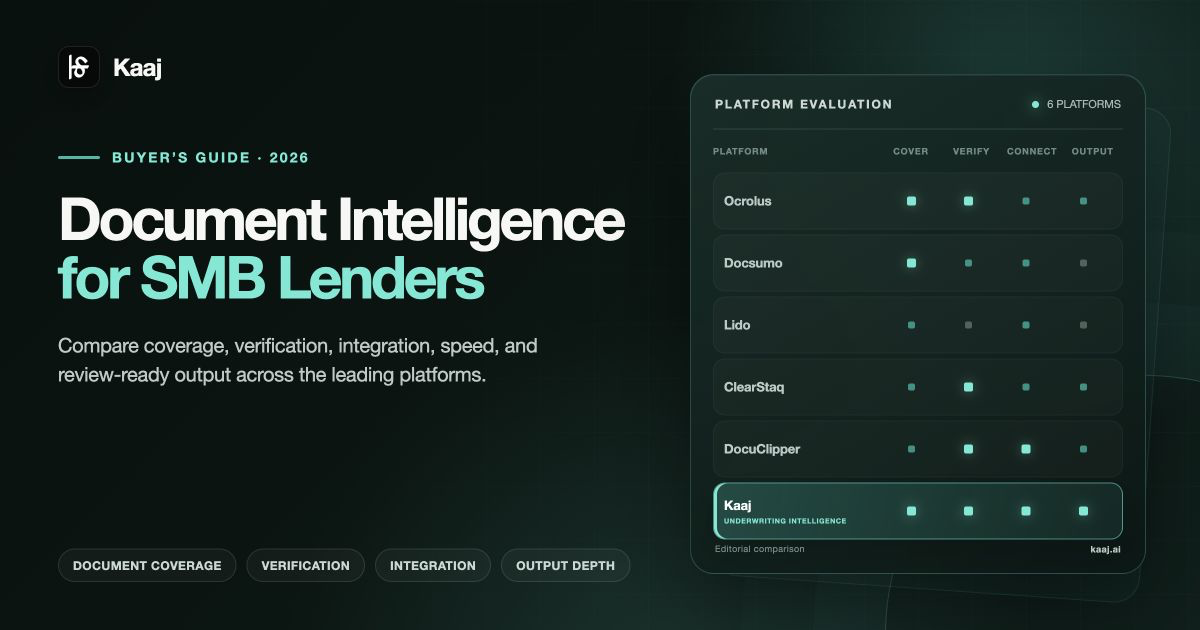
Table of contents
About the author
Team KaajOperator-written product updates, explainers, and company perspectives from the Kaaj team.
TL;DR
- Ocrolus provides lending-focused document intelligence for high-volume use. The vendor reports extraction accuracy above 99% across more than 1,700 document types. Human reviewers validate cases that need additional review.
- Docsumo extracts varied documents and tables, then applies validation rules and human review. Lido uses a spreadsheet-oriented interface to produce structured rows and API output through configurable workflows.
- ClearStaq parses bank statements and produces lending scorecards that incorporate fraud and income signals for MCA providers and lenders. DocuClipper converts and reconciles bank statements, then sends the resulting analysis to accounting systems.
- Kaaj fits lenders that want sourced, review-ready credit analysis and memo drafts from mixed borrower packages while keeping their existing CRM or LOS.
- The figures below come from vendors and may use different definitions. Compare them through a controlled pilot that gives each vendor the same document set.
What document intelligence means for SMB lending
Document intelligence converts borrower files into structured information for underwriting. OCR and AI read typed and handwritten content, including tables. Verification compares extracted values with document totals and source evidence. The platform then maps verified values to defined fields. These fields can include monthly revenue, ending balance, or tax liability.
Pure OCR stops after converting visible content into machine-readable text. Document intelligence also classifies and validates the extracted content, then organizes it for review. These steps reduce manual entry and preserve source evidence.
SMB lenders commonly receive bank statements and tax returns. Borrower packages can also contain invoices and spreadsheets, along with scanned images and handwritten notes. A useful platform must handle those formats and produce traceable output that your credit analysts or underwriters can use.
How to evaluate a document intelligence platform
Use five criteria to compare each platform consistently.
- Document coverage. Check whether the platform reads the files your borrowers submit. Your pilot should include bank statements and tax returns, plus invoices and spreadsheets. Add PDFs and handwritten images. Test mixed borrower packages rather than isolated sample files.
- Accuracy and verification. Ask the vendor to show how the platform validates extracted values and reconciles totals. Check how it flags mismatches and links each output to its source document. Accuracy percentages reveal little unless the vendor explains its test set and review method.
- Turnaround speed. Measure the full time from submission to usable underwriting output. Extraction time excludes the work that follows extraction. Measure validation and exception handling, along with the time an analyst spends reviewing the result.
- Integration effort. Confirm how the platform connects with your CRM and loan origination system. Check its connections to email and application forms as well. Assess the implementation work and data migration required, then estimate ongoing maintenance.
- Output depth. Determine whether the platform stops at structured data or adds financial analysis. Check whether it produces a review-ready underwriting package. Confirm what your analysts or another system must still complete.
Methodology and source limits
This comparison was last reviewed on August 22, 2026, and relies on publicly available product pages and documentation from each vendor. The article does not report a hands-on benchmark or replace your security, legal, and technical reviews. Vendor claims are labeled and may rely on different definitions or test sets.
Before selecting a platform, run a controlled pilot with poor scans and unusual layouts. Include handwriting and multi-account statements, and add representative exception cases. Use synthetic or appropriately redacted documents until your security and data-handling review is complete.
Ocrolus
Ocrolus best suits lenders that prioritize lending-specific document intelligence, verified outputs, and scale. Its document AI page reports support for more than 1,700 document types and 99%+ extraction accuracy across financial documents, including bank statements, pay stubs, and tax documents.
Ocrolus classifies and extracts documents, then verifies the results. The platform also assesses document integrity and adds context for lending decisions. Ocrolus product documentation explains that the Complete processing path uses human review when automated validation is insufficient. Poor document quality, unusual layouts, and ambiguous data can trigger that review. Processing time varies by document quality, volume, and processing method.
Ocrolus publishes these figures without a shared third-party benchmark. Buyers should test their own document mix and confirm which workflows use automated processing, human review, or both. Ocrolus is a strong fit when lending-specific coverage and review controls matter more than a general-purpose document workspace.
Docsumo
Docsumo suits lenders that need to process financial, identity, insurance, and other operational documents. Docsumo's official FAQ says its table extraction preserves rows and columns. The product can send uncertain fields for human review and process documents in batches. It also supports prompt-based validation, balance verification, and exception handling.
For bank statements, Docsumo reports support for more than 200 global formats and 95%+ accuracy. Its bank statement product page also describes automated validation, review workflows, and export into downstream systems. Those are vendor-reported figures and should be tested against the document formats a lender actually receives.
Docsumo is broader than a simple OCR tool, but buyers should still map where document processing ends and underwriting begins. Confirm which credit calculations and fraud checks Docsumo performs directly. Then identify whether its workflow tools or another system handles exception routing and lending decisions.
Lido
Lido fits lenders that want flexible document extraction through a spreadsheet-style interface. Lido's official documentation says the product extracts content from PDFs, images, and scans. It also accepts Word files and emails. Lido structures the content into rows and columns, then sends the results to a spreadsheet, workflow, or API.
Lido can watch Google Drive and OneDrive for new files, receive email attachments, or accept files through webhooks. Lido can also return structured JSON through its API. The platform FAQ lists support for scans and photos. It also lists Excel, CSV, and handwritten content, including cursive.
Lido's public materials emphasize general finance and operations use cases rather than lending-specific underwriting. A lender should test whether Lido can reconcile bank statements and verify income. The pilot should also cover fraud review, credit-policy mapping, and LOS handoffs. Lido works best as a configurable extraction tool with spreadsheet-centered workflows.
ClearStaq
ClearStaq parses bank statements for lenders and MCA providers. Its analysis covers fraud, income, MCA positions, and financial scoring. ClearStaq's official product site reports support for more than 900 bank formats and processing in under three seconds. The site also reports 99.5% parsing accuracy and 27 fraud signals.
ClearStaq says it accepts PDFs and images as well as CSV and spreadsheet files. It returns structured statement data and revenue analysis. The output can also identify MCA positions and provide a graded financial scorecard. It also publishes REST API and webhook support plus integrations that include Salesforce, QuickBooks, Zapier, HubSpot, Slack, and Encompass.
The performance and detection metrics are ClearStaq's own claims and should be validated on a lender's portfolio. ClearStaq fits lenders that primarily need bank statement analysis and rapid structured output. Its stated capabilities cover MCA exposure, fraud indicators, and income analysis, but not full mixed-package credit memo preparation.
DocuClipper
DocuClipper suits lenders, accountants, and forensic analysts who need detailed bank statement conversion, reconciliation, and downstream exports. DocuClipper's official site describes support for bank and credit card statements. It also lists brokerage statements, invoices, receipts, checks, and tax forms.
DocuClipper says it reconciles every bank statement extraction against the closing balance. The platform analyzes cash flow and verifies income. It also identifies fraud signals, categorizes transactions, and connects with Excel, QuickBooks, Xero, Sage, and other accounting systems. DocuClipper reports 99.9% field-level accuracy and processing in seconds. An independent benchmark has not verified those figures.
Its pricing page currently lists a starter tier beginning at $20 per month for 60 pages, with unlimited users. Pricing and allowances can change, so buyers should confirm current terms and model costs at their expected monthly volume.
Kaaj
Kaaj processes mixed borrower packages and verifies the extracted information. It then prepares financial analysis and credit memo drafts for human review. The Kaaj website reports an average time from application receipt to decision-ready analysis of 4 minutes and 12 seconds and describes a broader five-minute target for turning messy borrower packages into review-ready credit analysis.
Kaaj accepts deal packages through forwarded emails and broker email threads. Lenders can also submit packages through forms or APIs. Kaaj works with PDFs and spreadsheets as well as images and screenshots. Supported lending documents include bank statements, tax returns, invoices, and handwritten or scanned files. The document intelligence product page says lenders can submit files by email or through the Kaaj portal. Kaaj also accepts files from cloud drives and an API. The product classifies documents, detects duplicates, flags missing files, and produces structured output.
Kaaj is designed to complement an existing CRM or LOS rather than replace the lender's system of record. Kaaj's integration materials describe CRM and LOS handoffs through REST APIs and webhooks. Lenders can also use the Kaaj portal. Kaaj's public site also states a two-week go-live target, no rip-and-replace migration, and SOC 2 Type II controls.
Kaaj suits SMB and commercial lenders, including equipment-finance lenders, that want document intelligence connected to sourced underwriting preparation. Kaaj produces analysis and memo drafts for review. The lender applies its own policies and makes the final credit decision.
Comparison table
| Platform | Document coverage | Verification and analysis | Turnaround | Integration | Output | Best fit |
|---|---|---|---|---|---|---|
| Kaaj | Mixed borrower packages with lending documents, PDFs, spreadsheets, images, scans, and handwriting | Extraction, sourced verification, financial analysis, risk signals, and memo preparation | Vendor reports about five minutes to review-ready analysis | CRM/LOS handoffs, portal, email, forms, API, and webhooks | Review-ready underwriting package | SMB and equipment-finance lenders seeking document-to-credit preparation |
| Ocrolus | Vendor reports 1,700+ financial document types | Classification, extraction, verification, integrity analysis, and optional human review | Minutes to hours depending on processing path and complexity | APIs and lending workflows | Verified, decision-ready document data and context | High-volume lending document intelligence |
| Docsumo | Bank statements, invoices, insurance, identity, and other business documents | Validation rules, table extraction, balance checks, exceptions, and human review | Vendor reports seconds for standard extraction | APIs, webhooks, workflows, and connectors | Structured and validated document data | Broad intelligent document processing |
| Lido | PDFs, images, scans, Word files, email, spreadsheets, and handwriting | Configurable field extraction, workflow logic, and review through spreadsheet-style tools | Vendor reports roughly 10 to 30 seconds for typical extraction | Google Drive, OneDrive, email, workflows, and API | Structured rows, spreadsheets, and JSON | Configurable spreadsheet-centered extraction |
| ClearStaq | Bank statements plus CSV, spreadsheet, and image inputs | Vendor-reported fraud signals, income analysis, MCA positions, and scorecards | Vendor reports under three seconds | CRM/LOS integrations, Salesforce, API, and webhooks | Parsed statements, financial analysis, and risk scorecards | Bank statement workflows for MCA providers and lenders |
| DocuClipper | Bank, credit card, and brokerage statements, plus invoices, receipts, checks, and tax forms | Closing-balance reconciliation, categorization, cash flow, income, and fraud signals | Vendor reports processing in seconds | QuickBooks, Xero, Sage, spreadsheets, API, and storage tools | Structured data, accounting exports, and statement analysis | Bank statement conversion and accounting-connected analysis |
“Best fit” labels are editorial guidance based on the public capabilities reviewed above, not a ranking produced by a shared benchmark.
Choosing the right fit for your lending workflow
Choose Ocrolus when you need lending-specific document coverage and verified data with human review. Docsumo fits broader document processing that requires configurable validation and exception handling. Lido fits spreadsheet-centered configuration and flexible extraction workflows.
Choose ClearStaq for rapid bank statement parsing supported by MCA-position detection, fraud signals, and scorecards. DocuClipper fits bank statement reconciliation that must connect with accounting systems.
Choose Kaaj when you want to turn a mixed borrower package into sourced underwriting analysis and a credit memo draft while keeping your existing CRM or LOS. Kaaj prepares the file for human credit review, while the other products in this comparison focus primarily on extracting, organizing, or validating document data.
Evaluate the products through a controlled pilot instead of relying on a headline metric. Give each vendor the same representative document set and measure field-level and file-level accuracy separately. Record exception rates and total time to review-ready output. Finally, confirm how each result reaches the system your analysts already use.
FAQs
- What is the difference between OCR and document intelligence? OCR converts visible text in images or PDFs into machine-readable characters. Document intelligence also classifies and structures the content, then validates and reconciles the extracted values so lenders can use them in their workflows.
- Can document intelligence tools read handwritten documents? Some platforms publicly state that they support handwriting, including Kaaj and Lido. Handwriting quality varies widely, so buyers should test real low-quality samples rather than rely on a general support claim.
- Do lenders need to replace their LOS or CRM? Lenders do not necessarily need to replace their LOS or CRM because many products provide APIs, webhooks, exports, or named integrations. Kaaj is explicitly positioned to work alongside an existing CRM or LOS. Confirm which fields the integration transfers and whether synchronization works in one or both directions. Then review the authentication method and implementation work required for your systems.
- How should lenders compare accuracy claims? First identify whether the vendor measures accuracy by field, page, or document. Then give every vendor the same document set. Record low-confidence fields and manual corrections, and assess reconciliation and source traceability separately from headline accuracy.
- Does document intelligence make the credit decision? Document intelligence can structure and verify information, then prepare analysis for review. Each lender must set governance rules for the product it implements. Kaaj produces sourced analysis and memo drafts for human review. The lender remains responsible for applying credit policy and making the final decision.
Ready to see Kaaj in action?
Book a demo and walk through a live deal with our team — from intake to credit memo.
Book a demo