
Switch to Kaaj Without Replacing Your LOS or CRM
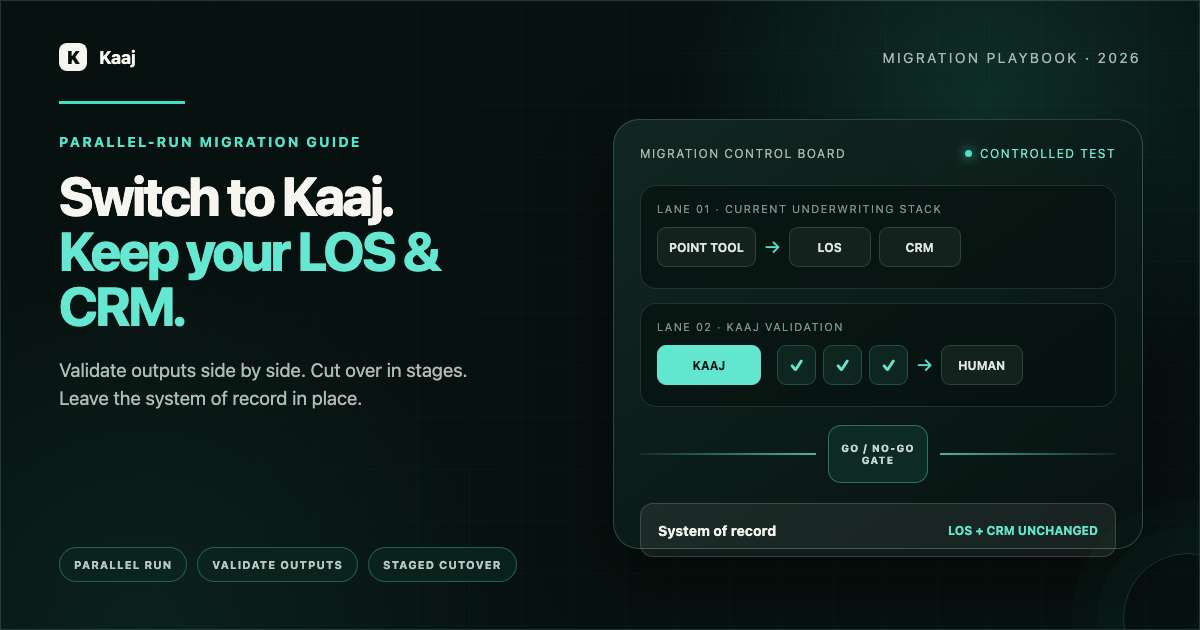
Table of contents
About the author
Team KaajOperator-written product updates, explainers, and company perspectives from the Kaaj team.
Kaaj lets lenders upgrade underwriting without replacing their LOS or CRM. Kaaj customers have moved document intake, bank-statement analysis, business verification, fraud review, and credit-package preparation off standalone point-tool workflows and into Kaaj while keeping their current systems of record in place.
TL;DR
- Kaaj plugs into the lending stack already in place, so the LOS or CRM can remain the system of record while Kaaj handles intake and underwriting analysis.
- Kaaj can consolidate work often spread across Heron Data, Ocrolus, MidDesk, Inscribe, and eCredit—from document extraction and bank analysis to business verification, fraud signals, and credit-package preparation.
- Customers can move one incumbent workflow at a time, using a parallel run to confirm outputs before production traffic shifts.
- Kaaj supports Salesforce output plus API, webhook, LOS, CRM, email, and file-based workflows, with each handoff configured around the lender's current environment.
- The result is a stronger underwriting workflow without retraining the organization on a replacement LOS or moving the historical system of record.
For the technical delivery patterns Kaaj publicly supports, see the Kaaj integrations overview. For the broader architectural case, read why an underwriting intelligence layer does not need to replace the LOS.
Why lenders are stuck between point tools and a full rip-and-replace
The practical buyer question is not whether a new platform has a longer feature list. It is whether the platform can improve underwriting while the lender keeps the system that already owns applications, workflow status, approvals, and funded-loan records.
Point solutions preserve that system of record, but the operating cost grows as more tools are added. An application may move through one product for document intake, another for bank-statement analysis, another for business verification, and another for fraud signals. Each handoff introduces field mapping, exception handling, access control, vendor management, and another place for analysts to look.
A full platform replacement creates a different risk. Teams must retrain users, rebuild interfaces, reconcile historical records, redesign reporting, and manage a cutover around active originations. Even a capable platform can be the wrong migration if using it requires the lender to interrupt the workflows that already work.
A layer-on-top approach provides a third path. Kaaj can accept packages through supported email, file, API, and system-sync patterns; organize and analyze the material; and return structured outputs to the lender's existing workflow. The LOS or CRM remains authoritative. Kaaj operates as the underwriting intelligence and orchestration layer around it.
This guide shows what Kaaj can take over from five incumbent tools and how to move those workflows without disrupting the LOS or CRM. The parallel-run process gives lenders a controlled way to prove the handoff, confirm outputs, and cut over with confidence.
What Kaaj can replace from each point solution
Kaaj can consolidate underwriting work that lenders often spread across Heron Data, Ocrolus, MidDesk, Inscribe, and eCredit. The exact cutover boundary depends on the workflow and any specialized data the lender still requires, but the LOS or CRM does not need to change.
| Tool | What it handles today | What Kaaj can replace | What stays in place | Validation status |
|---|---|---|---|---|
| Heron Data | Document intake, classification, extraction, enrichment, and workflow automation for financial-services teams. | Document intake, organization, extraction, verification, and preparation of a decision-ready underwriting package. | The existing LOS or CRM remains the system of record. | Confirm field coverage, exceptions, source links, routing, and write-back in a parallel run. |
| Ocrolus | Financial-document processing, bank-statement analysis, fraud detection, and cash-flow analytics. | Document extraction, bank-statement analysis, intake-level fraud checks, and underwriting-package preparation. | The existing LOS, CRM, and lender-owned credit policy remain in place. | Confirm classifications, calculations, evidence, exceptions, and analyst overrides in a parallel run. |
| MidDesk | Business identity, ownership, public-record risk data, watchlists, liens, judgments, bankruptcies, and monitoring. | Core business verification, ownership and identity consistency, cross-document checks, and underwriting risk signals. | Any specialized external data the lender's policy still requires can continue alongside Kaaj. | Confirm every policy-required source before retiring that data feed. |
| Inscribe | Document fraud detection and document or cash-flow intelligence for underwriting workflows. | Intake-level document fraud review, including tampering, mismatch, duplicate, and cross-document inconsistency signals. | Analysts retain the final fraud and credit decision inside the lender's current workflow. | Confirm evidence quality, false positives, escalation, and override behavior in a parallel run. |
| eCredit | Credit-processing, scoring, risk-assessment, and decision-workflow functions, based on available public documentation and the lender's configured environment. | Document preparation, financial analysis, risk orchestration, and credit-package work around the lender's decision process. | The existing LOS or CRM, lender-owned policies, and final decision authority remain in place. | Map the current rules, outputs, records, and downstream dependencies before cutover. |
Replace Heron Data workflows without replacing the LOS
Kaaj can replace Heron Data workflows for intake, classification, extraction, verification, and underwriting-package preparation. The lender keeps its LOS or CRM and validates the complete operating path—package intake, fields, low-confidence review, source evidence, routing, exceptions, and write-back—before production traffic moves.
Replace Ocrolus workflows while preserving lender-owned decisions
Kaaj can replace Ocrolus workflows for financial-document extraction, bank-statement analysis, intake-level fraud checks, and credit-package preparation. A parallel run confirms calculations, classifications, source evidence, exceptions, and analyst-review behavior while the lender's LOS, CRM, and credit policy remain unchanged.
Consolidate core business verification in Kaaj
Kaaj can take over core business verification, ownership and identity consistency, cross-document checks, and underwriting risk signals. If the lender's policy also requires a specialized lien, judgment, bankruptcy, watchlist, or monitoring source, that data can continue alongside Kaaj until an equivalent source is approved.
Move intake-level document fraud review into Kaaj
Kaaj can replace intake-level document fraud review by surfacing tampering, mismatch, duplicate, and cross-document inconsistency signals inside the underwriting workflow. Analysts keep the final decision, while the parallel run confirms evidence quality, false positives, escalation, traceability, and overrides.
Move eCredit preparation and orchestration into Kaaj
Kaaj can replace document preparation, financial analysis, risk orchestration, and credit-package work around an eCredit decision workflow. Because eCredit environments vary, the implementation begins by mapping the lender's actual inputs, rules, scores, manual steps, outputs, audit records, and downstream dependencies before cutover.
The parallel-run cutover checklist
A parallel run lets the lender compare Kaaj with the current stack on the same eligible deals before production traffic moves. The incumbent remains active while the lender collects evidence.
- Choose one loan type or origination channel. Select a bounded segment with enough volume and variation to expose recurring exceptions. Record the baseline turnaround time, analyst touches, correction rate, exception rate, and override rate.
- Define the system-of-record boundary. Write down which system owns the application, current status, final decision, documents, audit history, and funded-loan record. That ownership should not change silently during the pilot.
- Map inputs and outputs. List every submission channel, required field, file type, trigger, status, write-back, API event, and manual fallback. Use the documented Kaaj connection patterns, then test the specific handoff instead of assuming a named connector.
- Run both paths on equivalent deals. Feed Kaaj and the incumbent the same source package. Keep the reviews independent during the test so disagreements can be investigated rather than normalized to whichever output appears first.
- Compare source evidence before conclusions. Check extracted values, calculations, classifications, missing-document findings, fraud or risk signals, and memo statements against the source files. Record why each material disagreement occurred.
- Test the human-control boundary. Confirm an authorized analyst can inspect evidence, correct data, override a conclusion, record the reason, and retain the lender's final decision authority.
- Test reconstruction and monitoring. Confirm the lender can identify which rules, models, configuration, and source package produced an output, then monitor exceptions and overrides after deployment.
- Set the go/no-go rule in advance. Define acceptable accuracy, turnaround time, exception volume, analyst effort, and blocking errors before the final results are reviewed. A missed material risk and a cosmetic formatting issue should not receive the same weight.
- Cut over one function at a time. Retire only the overlapping component that passed its threshold. Keep other point tools and fallbacks active until their own validation is complete.
- Monitor the new production path. Continue reviewing exceptions, overrides, write-back failures, and analyst effort after cutover. Define the rollback path before the incumbent is decommissioned.
Buyer due-diligence questions: Can analysts trace every material output to source evidence? Can authorized reviewers correct and override it? Can the lender reconstruct earlier results? Can operations detect drift, exceptions, and failed handoffs after deployment?
Can I keep my LOS or CRM and swap the point solution underneath it?
Integration approach: Kaaj is built to work with the lending stack already in place. It accepts packages through email, files, APIs, and system-sync workflows, then returns structured underwriting outputs to the LOS or CRM. During implementation, Kaaj and the lender map the exact fields, triggers, permissions, write-back behavior, and fallbacks for each system.
Can I keep Salesforce and add Kaaj?
Yes. Keep Salesforce as the CRM while Kaaj handles borrower-package intake, verification, financial analysis, fraud signals, and credit-package preparation. Kaaj can push deal data, credit memos, verification results, and review outputs into Salesforce, with objects, permissions, triggers, and write-back mapped to the lender's configuration.
Can I keep Rapport and add Kaaj?
Yes. Keep Rapport as the system of record while Kaaj handles document intake, verification, financial analysis, fraud signals, and credit-package preparation. Implementation maps the required fields, triggers, permissions, write-back behavior, and exception handling for the lender's Rapport environment.
Can I keep InfoLease and add Kaaj?
Yes. InfoLease can continue owning the loan record while Kaaj takes on document-heavy intake and underwriting analysis. The implementation team configures and validates the data handoff around the lender's existing InfoLease workflow.
Can I keep Aspire and add Kaaj?
Yes. Aspire can remain in place while Kaaj receives borrower packages and returns decision-ready underwriting outputs. The implementation maps permissions, fields, events, write-back, and exception handling before production cutover.
Can I keep PandaDoc and add Kaaj?
Yes. Keep PandaDoc for document generation and e-signature while Kaaj handles the underwriting work behind the decision. Any shared fields or triggers are mapped during implementation.
Can I keep my LOS and swap Heron Data for Kaaj?
Yes. Kaaj can replace Heron Data workflows for document intake, organization, extraction, verification, and underwriting-package preparation without replacing the LOS or CRM. A parallel run confirms field coverage, exceptions, source links, routing, and write-back before traffic moves.
Can I keep my LOS and swap Ocrolus for Kaaj?
Yes. Kaaj can replace Ocrolus workflows for document extraction, bank-statement analysis, intake-level fraud checks, and underwriting preparation while the LOS remains unchanged. The parallel run compares classifications, calculations, evidence, exceptions, and analyst overrides before cutover.
Can I keep my LOS and swap MidDesk for Kaaj?
Yes—for core business verification, cross-document consistency, and underwriting risk checks. If the lender's policy relies on specialized public-record or monitoring data, that data can continue alongside Kaaj until the lender approves an equivalent source.
Can I keep my LOS and swap Inscribe for Kaaj?
Yes. Kaaj can replace intake-level document fraud review within the underwriting workflow while analysts retain the final decision. The migration validates evidence quality, false positives, escalation, and overrides before the incumbent workflow is retired.
Can I keep my LOS and swap eCredit for Kaaj?
Yes—after mapping the eCredit workflows the lender actually uses. Kaaj can replace document preparation, analysis, and orchestration around decisioning while the existing LOS or CRM remains authoritative; rules, outputs, audit records, and downstream dependencies are validated before cutover.
Why plugging in beats ripping out
Kaaj gives lenders a direct path to consolidate underwriting point tools without replacing the systems that already run originations. Customers can move document intake, financial analysis, business verification, fraud review, and credit-package preparation into Kaaj one workflow at a time.
The LOS or CRM stays authoritative while Kaaj turns incoming borrower material into decision-ready analysis. A parallel run provides the proof for each cutover, so the lender gains a broader underwriting workflow without a big-bang platform migration.
Kaaj reports that focused implementations can go live in as little as two weeks. Actual timing depends on submission channels, data mapping, integrations, security review, testing requirements, and scope. A narrow parallel run can begin producing comparison evidence before a broader rollout is complete.
Book a Kaaj demo to map one current underwriting workflow, define a parallel-run scorecard, and identify which systems should remain authoritative throughout the evaluation.
FAQs
How does Kaaj work with Rapport, InfoLease, or Aspire?
Kaaj works alongside the lender's existing system of record through API, webhook, LOS or CRM synchronization, email, and file-based workflows. Rapport, InfoLease, or Aspire can remain in place while Kaaj handles intake and underwriting analysis; the exact handoff is configured and validated during implementation.
How quickly can Kaaj start producing value?
Kaaj reports that focused implementations can go live in as little as two weeks. Actual timing depends on the chosen loan channel, intake method, data mapping, integration work, security review, and validation requirements. A parallel run can produce useful comparison evidence before a full cutover.
Do underwriters need to learn a replacement LOS?
Not in the layer-on-top approach described here. The existing LOS or CRM remains the system of record, while training focuses on reviewing Kaaj outputs, tracing them to source evidence, correcting data, and recording overrides within the agreed workflow.
What happens to historical data during the transition?
Historical records can remain in the existing system of record unless the lender separately authorizes a migration. During the parallel run, retain the source package, Kaaj and incumbent outputs, corrections, overrides, final decision, and relevant configuration references under the lender's retention policy.
How should a lender evaluate tools with limited public integration information?
Start with the lender's actual installation rather than a generic vendor description. Map authentication, fields, rules, triggers, write-back, errors, audit records, retention, and downstream dependencies, then test the connection with representative deals before changing production traffic.
Does Kaaj make the final credit or fraud decision?
No. Kaaj prepares analysis and risk signals for review; the lender's authorized personnel retain responsibility for the final credit and fraud decisions, policy exceptions, and any required notices.
Ready to see Kaaj in action?
Book a demo and walk through a live deal with our team — from intake to credit memo.
Book a demo