
How Lenders Automate Broker and ISO Intake Without Losing Commission Control
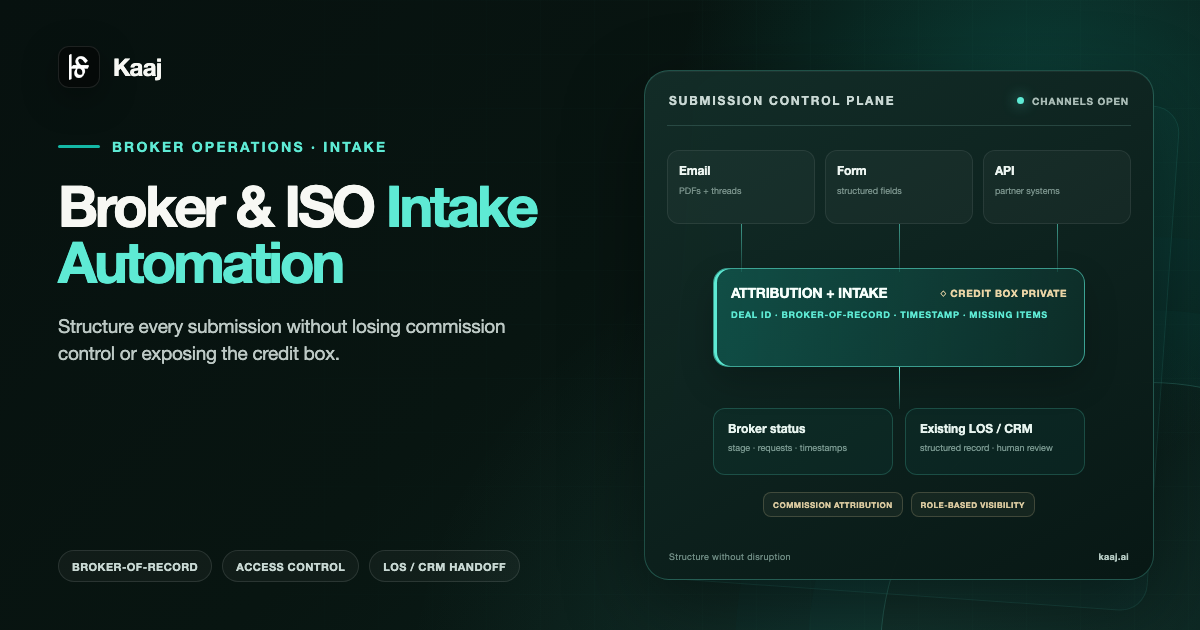
Table of contents
About the author
Team KaajOperator-written product updates, explainers, and company perspectives from the Kaaj team.
Broker/ISO intake automation is the practice of routing broker-submitted equipment-finance or MCA applications into a lender's existing LOS or CRM through email, forms, a portal, or an API—while preserving broker-of-record attribution and keeping underwriting criteria private.
TL;DR
- A structured submission layer can feed broker packages into an existing LOS or CRM without forcing every broker onto a new portal.
- Email intake creates duplicate records, lost attachments, unclear status, and broker-of-record disputes as submission volume grows.
- Portal-first intake provides centralized visibility but requires broker adoption. API-first intake preserves existing system behavior but requires dependable integrations and a fallback for smaller partners.
- Any digital lending platform used for intake should preserve commission attribution while keeping scorecards, pricing logic, and approval thresholds private.
- Kaaj accepts structured and unstructured submissions, prepares decision-ready analysis, and sends structured outputs into existing lending workflows.
Why email-based intake collapses past a few dozen brokers
Email intake depends on staff memory and manual triage, so processing capacity—not a specific broker count—determines when the workflow starts to fail. At low volume, a coordinator can connect each message with its attachments, broker, and current status. Once submissions arrive faster than staff can classify and route them, the inbox becomes the operating system.
Duplicate submissions become difficult to identify because email provides no consistent deal identifier. A broker may resend a package after adding one document, while another ISO may submit the same borrower through a separate thread. Staff must compare names, files, and timestamps before deciding whether to merge the records or treat them as separate opportunities.
Attachments also separate the deal record across inboxes and message chains. An underwriter may review an older bank statement while a salesperson has the replacement in another thread. When a broker requests an update, each person may report a different status because no shared record shows the latest package and review stage.
Email also weakens commission attribution. Forwarded messages can obscure the original broker, and manual data entry can assign the wrong broker of record. If two brokers claim the same borrower, the lender has to reconstruct the submission history before applying its commission policy. These broker-to-lender handoff failures become harder to resolve when the original sender, package, and timestamp are not tied to one deal record.
Any replacement must preserve broker identity at the moment of submission and carry that attribution into the lender's LOS or CRM. The broker-facing channel should also show enough information to support follow-up without exposing internal scorecards, pricing logic, policy exceptions, or approval thresholds.
Portal-first vs. API-first for multi-lender submission workflows
What is portal-first intake?
A portal-first model centralizes broker intake in one interface. Brokers enter applications, upload documents, review missing items, and check deal status through the portal. The lender gains a consistent submission record and one place to manage communication. The tradeoff is adoption: brokers must learn another interface and maintain another login, which can slow participation among occasional or lower-volume partners.
What is API-first intake?
An API-first model sends submission data into the lender's existing LOS or CRM. High-volume brokers can connect their systems directly, while lenders preserve familiar internal queues and reporting. APIs require technical work on both sides, and smaller brokers may not have resources to build an integration. Lenders still need a path for emails, PDFs, spreadsheets, and screenshots.
A middle layer can support both paths without making either mandatory. It can accept broker packages through existing channels, convert documents and messages into structured fields, and pass the resulting record into the lender's current systems. Brokers can keep using email or a simple form, while partners with technical capacity submit through an API.
Kaaj's broker workflow follows this layer-on-top approach. It can accept inbox, form, file, and API submissions, then prepare structured outputs for an existing lending workflow. The LOS or CRM remains the system of record; Kaaj is the intake and pre-underwriting intelligence layer.
The right architecture depends on broker behavior, the systems the lender already runs, and whether the workflow serves one capital provider or a multi-lender platform. In every case, define attribution, permissions, delivery, and fallback behavior before choosing the interface.
Keeping commission tracking and the credit box intact
| Broker sees | Lender keeps private |
|---|---|
| Submission stage: received, under review, approved, declined, or funded | Scorecards, risk models, and policy rules |
| Missing-document requests and timestamps | Pricing logic and approval thresholds |
| Deals submitted through the broker's account | Full borrower package and internal notes |
| Commission status for the broker's own deals, if the lender chooses to expose it | Buy rate, investor spread, policy exceptions, and internal commentary |
Commission tracking should begin when the intake layer receives a submission. The workflow should assign a unique deal ID and record the broker's authenticated account or legal entity, submission channel, and timestamp. It should also preserve the commission schedule or rule version that the lender applies to that deal. These fields give the LOS or CRM a consistent broker of record instead of relying on an email signature or file name.
Submission lifecycle: Received → attributed to broker of record → under review → status updated → funded → commission calculated under the lender's policy.
Duplicate rules should flag competing claims without silently changing attribution. If two ISOs submit the same borrower, the intake layer can identify matching business details and pause the second submission for review. An authorized employee resolves the conflict under the lender's policy, while the record retains the submissions and any attribution change.
Role permissions should apply to both portal screens and API responses. A broker can see deals submitted through its account, the current stage, requested documents, and relevant timestamps. Underwriters can see the full borrower package, internal notes, risk signals, pricing logic, approval thresholds, and scorecards.
Public status labels should map to internal workflow stages without revealing why a credit decision occurred. A broker might see “under review,” “additional information required,” “approved,” or “declined.” Internal model outputs, policy exceptions, and employee commentary remain inside the lender's controlled workflow.
A structured event history gives operations and compliance teams a timestamped record to work from during commission disputes or internal reviews. Kaaj can ingest submissions and synchronize documents and structured outputs with an existing LOS or CRM. Each lender should confirm with its own legal and compliance teams whether its overall recordkeeping configuration meets applicable retention, licensing, and review requirements.
A 50+ broker onboarding checklist that does not stall operations
Avoid a big-bang cutover. Structure intake behind the scenes while brokers continue using familiar submission methods during a controlled transition.
| Phase | Action | Owner | Fallback |
|---|---|---|---|
| 1 | Tier brokers by submission volume | Broker operations | Keep low-volume partners on monitored email |
| 2 | Map each broker's submission formats | Operations + implementation | Accept original files while mappings are tested |
| 3 | Assign identity, broker-of-record, and access level | Operations + security | Hold activation until permissions are verified |
| 4 | Migrate one tier at a time | Program owner | Route the existing inbox through the new intake layer |
| 5 | Set a fixed communication cadence | Broker success | Office hours and direct support during the first week |
- Tier brokers by submission volume. Move a small group of frequent submitters first because their activity exposes workflow problems quickly. Keep low-volume and inactive brokers on the existing email channel until the intake rules have been tested.
- Map the formats each broker uses. Record whether each partner sends applications, spreadsheets, PDFs, screenshots, or email threads. Configure the intake layer to classify those files and extract required fields instead of forcing every broker to rebuild packages in a new template. Kaaj's document-intelligence workflow supports structured and unstructured submissions from common lending channels.
- Assign credentials and access before activation. Give each broker a unique identity, broker-of-record value, commission profile, and permitted user list. Broker access should cover submission status, missing documents, and timestamps. Keep scorecards, pricing logic, approval thresholds, and internal notes restricted to lender staff.
- Migrate one tier at a time. Run the new path alongside the existing inbox for a defined testing period. Route forwarded emails through the intake layer so brokers can continue submitting as usual while operations receives structured records. Review duplicate flags, missing-field flags, attribution accuracy, and delivery into the existing LOS or CRM before expanding.
- Use a predictable communication cadence. Notify brokers before activation, provide a short submission guide when access opens, and hold an office hour during the first week. Follow up with brokers who continue using the fallback inbox and address the specific obstacle before removing that path.
Name one owner for migration exceptions and keep a broker roster with activation dates, access levels, test results, and fallback usage. That record lets the team resolve onboarding issues without interrupting active deals.
Handling incomplete or messy submissions without bouncing brokers
A lender should create a submission record even when the broker sends an incomplete package. The intake layer can classify applications, bank statements, invoices, identity documents, and other files inside PDFs or email threads, extract available fields, and preserve each original file for review.
A completeness check should compare the extracted package with the lender's requirements for that product and channel. Instead of returning a generic rejection, the workflow should identify specific problems such as a missing March bank statement, an unsigned application, or an unreadable driver's license. The broker pre-submission checklist defines what should be present before a lender-ready handoff; the intake layer applies those requirements consistently at scale.
Confidence thresholds keep automation from turning uncertain data into underwriting facts. The workflow can route unclear values, conflicting business names, or suspected duplicates to an operations reviewer. Verified fields continue into the lender's process, while unresolved fields remain visibly pending.
Follow-up documents should attach to the original submission ID rather than create another deal record. When a broker replies by email or uploads another file, the workflow can rerun extraction and completeness checks while preserving attribution, timestamps, and the clarification history.
Giving brokers real-time status without opening the black box
A broker status view should report process facts without revealing how the lender evaluates a deal. Each submission can display its current stage—received, under review, awaiting documents, approved, declined, or funded—plus missing items and the last-updated timestamp.
Role-based permissions should keep underwriting details inside the lender's systems. Brokers should not see scorecards, approval thresholds, internal notes, model outputs, or pricing calculations. Any broker-facing decline category should follow the lender's approved communication and adverse-action processes rather than exposing an underwriter's free-form comments.
Reliable updates reduce check-in emails because brokers can answer basic process questions without contacting the operations team. Timestamps also show whether a file is moving or waiting on the broker. Kaaj can surface approved workflow fields or synchronize them with an existing CRM or LOS, subject to the lender's configured integration and access model.
LendFoundry vs. Lendflow vs. Heron Data for broker intake
Kaaj is an intake and pre-underwriting intelligence layer that ingests broker and ISO submissions and prepares decision-ready analysis for a lender's existing LOS or CRM. It is not positioned as the lender's LOS, servicing system, or autonomous final decision-maker.
| Provider | How the provider describes its scope | What a broker-intake buyer should confirm |
|---|---|---|
| LendFoundry | A digital lending platform with loan-origination and loan-servicing modules, plus portal and workflow capabilities. | Which modules are required, what remains the system of record, and how existing broker channels and commission data are handled. |
| Lendflow | Embedded lending infrastructure with modular connectivity, a lender network, widgets, and a unified API. | Whether the intended workflow is embedded distribution, multi-lender routing, direct-lender broker intake, or a combination—and which party owns each record. |
| Heron Data | Document-heavy workflow automation covering intake, extraction, enrichment, and synchronization of structured data. | Whether the current product scope covers broker attribution, permissioned status, and the full handoff required by the lender—not only document extraction. |
| Kaaj | A layer for submission intake, document intelligence, pre-underwriting analysis, and handoff into existing lending workflows. | Which channels, output fields, review gates, and LOS/CRM handoffs are in scope for the initial implementation. |
The practical comparison is not “which company has more features?” It is: how much broker behavior must change, which system remains authoritative, where human review occurs, and whether the selected scope carries the submission from messy intake to a decision-ready file.
Kaaj's differentiation is the operating boundary. Brokers can continue using supported email, form, file, or API channels while Kaaj organizes the package and prepares analysis for the lender's existing workflow. Kaaj reports that focused implementations can go live in two weeks without a rip-and-replace migration; actual timing depends on channels, integrations, security review, and scope.
Getting started without disrupting active broker relationships
Start with the channels already carrying active deals. Select a small group of frequent brokers, define the submission record and permission model, route their existing channel through the intake layer, and validate attribution and delivery before expanding.
A layer above current systems can improve intake speed while preserving commission attribution, access controls, and human-owned underwriting rules. Book a Kaaj demo to map a broker submission workflow without replacing the systems or relationships already working.
FAQs
What is broker and ISO intake automation?
It is the use of structured workflows to receive broker-submitted applications and documents, attach them to a broker of record and deal ID, identify missing items, and route the resulting record into a lender's existing systems. The workflow can accept email, forms, portals, APIs, or a combination.
How long does implementation take?
Timing depends on submission channels, integration scope, security review, and the fields the lender needs returned. Kaaj reports that focused deployments can go live in two weeks, while broader rollouts can be phased by broker tier or workflow.
Do brokers need training on a new portal?
Not necessarily. A portal-first design requires brokers to learn a new interface, but an integration-first layer can ingest forwarded emails, forms, files, or API submissions. A lender can preserve familiar broker behavior while structuring the record behind the scenes.
How is commission attribution preserved?
Record the authenticated broker or legal entity, broker-of-record value, submission channel, timestamp, and applicable commission-rule version when the deal enters the workflow. Carry those fields into the lender's LOS or CRM, where commission policy remains managed.
Does the lender's credit box stay private?
It should. Separate broker-facing status fields from internal scorecards, approval thresholds, pricing logic, model outputs, exceptions, and notes. Apply the same permissions to portal screens, exports, and API responses.
How do lenders onboard 50 or more brokers without overwhelming underwriting?
Tier brokers by volume, map their existing formats, assign identity and access before activation, and migrate one tier at a time with monitored email as a fallback. Test duplicate flags, missing-item requests, broker attribution, and LOS/CRM delivery before expanding.
What changes when a deal is boarded as broker versus dealer?
The intake record should preserve the submitting party's legal role, entity, channel, and agreement so the lender can apply its own commission, licensing, and routing rules. Those rules vary by product and jurisdiction; configure them with the lender's legal and compliance teams rather than inferring them from the submission label.
Why do broker submissions fail, and how do lenders stop incomplete packages?
Packages fail when files are missing, duplicated, unreadable, inconsistent, or detached from the original deal record. Create the record first, identify the exact missing or uncertain item, route low-confidence values to human review, and attach every follow-up file to the same submission ID.
Ready to see Kaaj in action?
Book a demo and walk through a live deal with our team — from intake to credit memo.
Book a demo