
Best KYB Software for Small Business Lenders in 2026
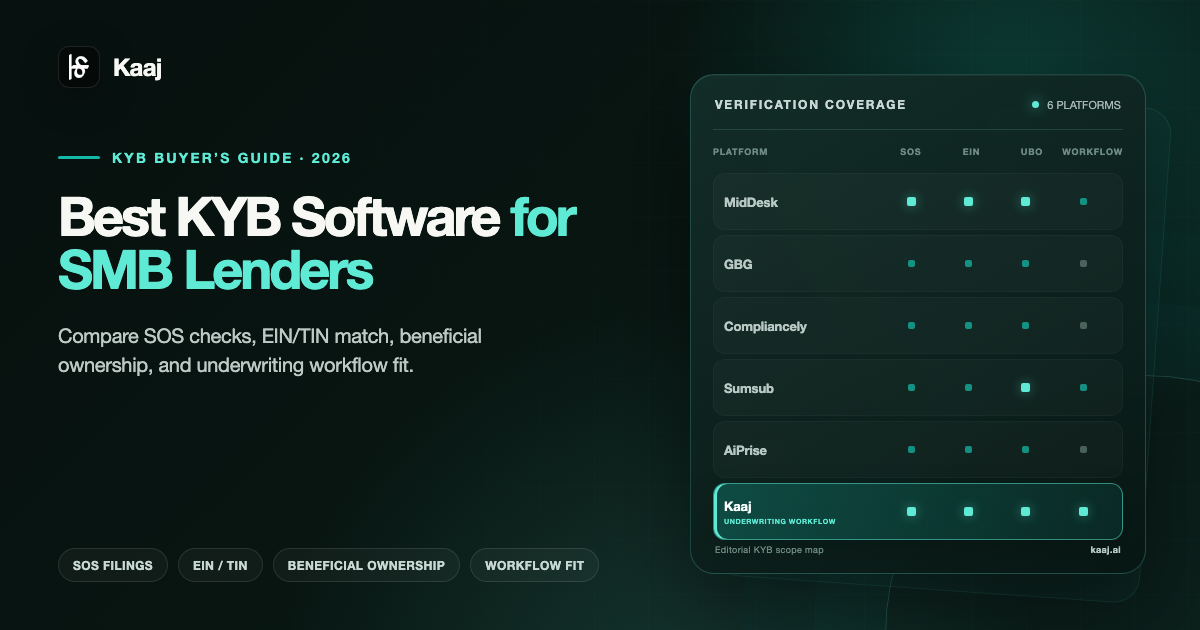
Table of contents
About the author
Team KaajOperator-written product updates, explainers, and company perspectives from the Kaaj team.
TL;DR
- KYB software verifies a business through secretary of state filings, EIN/TIN matching, beneficial ownership checks, and sanctions screening.
- Kaaj is the best fit for lenders that need KYB inside a broader workflow covering document intake, fraud detection, and credit memo creation.
- Standalone KYB tools such as Middesk suit lenders that already have underwriting infrastructure and need a business verification API or compliance screening feed.
- Kaaj overlays an existing LOS or CRM, so lenders can add verification and underwriting automation without replacing their current system.
What KYB software does for small business lenders
KYB software verifies that a borrower is a legitimate business and connects its legal identity, tax identity, ownership, and screening results to the loan application. Lenders use KYB verification during onboarding and underwriting to identify shell companies, misrepresented entities, and prohibited parties before a lending decision.
State business-registration validation confirms that the applicant's legal name, registration status, formation jurisdiction, and filing details match government records. EIN or TIN matching checks whether the business name and federal tax identifier match the authoritative tax records available through the provider's verification service. Together, these checks can expose altered applications, inactive entities, and identity mismatches before the lender evaluates creditworthiness.
Beneficial-ownership verification identifies the people who ultimately own or control the company. Depending on its data sources, KYB software may compare ownership information across applications, corporate records, and submitted documents. Sanctions and watchlist screening then checks the business and relevant owners against restricted-party data. A lender may need additional review when names, addresses, ownership percentages, or control relationships conflict.
KYC and KYB cover different subjects. KYC verifies an individual's identity, while KYB verifies a business and its relationship to its owners or controllers. Small business lenders often need both because a valid company registration does not prove that the person applying controls the business. KYB gives the lender a verified entity record that can support fraud review, compliance checks, and the later credit decision. For SOS-focused lender guidance, see KYB 101 for lenders.
Standalone KYB tools vs. underwriting workflow platforms
Standalone KYB software verifies a business and returns structured results through an API or dashboard. A lender must then map those results into its loan origination system or credit process. Without an integration, staff may rekey filing status, tax identification matches, and ownership details into the credit file.
An underwriting workflow platform uses KYB results as evidence within a broader review. The platform can ingest borrower documents and compare extracted information with verification records. It can also surface fraud indicators and draft a credit memo that cites the supporting data.
Choose the category based on the work your existing decision system already handles. A point solution works well when your LOS already handles document review, risk analysis, and credit decisions, and you only need a verification feed. A workflow platform fits when staff still move information between inboxes, verification portals, spreadsheets, and memo templates.
An overlay platform such as Kaaj can connect with an existing LOS or CRM without forcing a replacement. You keep your current system of record while the platform adds document intake, KYB verification, fraud checks, and underwriting outputs around it. Choose a point solution for business verification data alone or an overlay platform for verification embedded in underwriting. See also Kaaj and Middesk comparison for a direct overlay-versus-entity-KYB contrast.
Comparison table: KYB and business verification tools for 2026
The table distinguishes documented capabilities from items that require confirmation. Verify coverage, jurisdictions, data sources, and integration details directly with each vendor because product capabilities can change.
| Vendor | SOS filings | EIN/TIN match | Beneficial ownership | Document intake | Fraud detection | Credit memo output | LOS/CRM model |
|---|---|---|---|---|---|---|---|
| Kaaj | Yes | Yes | Yes (ownership / principal matching) | Yes | Yes (document + package) | Yes | Overlay |
| Middesk | Yes (50-state) | Yes (EIN/TIN verification) | Yes (UBO + principal KYC) | Formation and state filing documents | Yes (pre-funding risk signals) | Underwriting-file assembly; confirm credit memo capabilities | API into existing LOS |
| GBG | Global identity / business data | Vendor-dependent | Vendor-dependent | Unconfirmed for lending packages | Yes (identity / fraud data) | Confirm credit memo capabilities | Enterprise data / compliance |
| Compliancely | Positioned for KYB / AML checks | Confirm in eval | Confirm in eval | Unconfirmed | Compliance screening | No confirmed memo OS | Point compliance |
| Signzy | Confirm in eval | Confirm in eval | Confirm in eval | Digital onboarding | Confirm in eval | No confirmed memo OS | Banking / fintech onboarding |
| Sumsub | Confirm in eval | Confirm in eval | Business + individual ID | Identity documents | Compliance fraud checks | No confirmed memo OS | KYC/KYB compliance platform |
| AiPrise | Global registry aggregation | Confirm in eval | Business verification | Unconfirmed | Confirm in eval | No confirmed memo OS | Aggregated global KYB APIs |
Kaaj: KYB verification inside a full underwriting workflow
Kaaj is the recommended choice for lenders that want KYB verification to become part of the credit decision. The platform verifies Secretary of State filings and matches EIN or TIN details. It also checks submitted beneficial-ownership and principal information before incorporating the results into the broader underwriting review.
Kaaj works as an overlay on your existing loan origination system or CRM. You can send borrower packages through email forwarding, an API, embedded forms, or the Kaaj portal. Kaaj then returns structured information and underwriting outputs without requiring lenders to replace their current system. Confirm migration and integration requirements for the proposed implementation. Integrations such as Salesforce keep verification and analysis connected to the system of record.
Kaaj connects business verification with document review, fraud detection, and credit memo drafting within one workflow. For example, the platform can compare verified business information with applications, bank statements, and financial records. It can flag inconsistencies or indicators of document alteration and cite the supporting evidence in a draft credit memo for underwriter review. An underwriter can review the findings without copying a standalone KYB result into another tool.
Kaaj best suits SMB and equipment finance lenders that have an LOS or CRM but still handle document review, verification data, and credit memo drafting manually. Lenders that only need a KYB response through an API may prefer a point solution such as MidDesk. Lenders seeking to consolidate verification and underwriting work will find Kaaj better suited to the full workflow. Product overview: AI underwriting platform.
Middesk: best for API-first business verification
Middesk fits lenders that want business verification through an API and already have their own onboarding and decision systems. Middesk documents business-registration coverage across all 50 states, EIN/TIN verification, beneficial-owner and principal identity checks, sanctions and politically exposed person screening, web-presence signals, and formation-document verification. For lenders, MidDesk also positions credit and lien screening plus UCC filing support alongside KYB.
Choose MidDesk when you can route verification data into existing underwriting logic and review queues, and you primarily need a business-identity foundation rather than an underwriting OS. Middesk can assemble underwriting files and surface fraud signals, while its primary focus remains KYB and business identity. Lenders that need document-package intake, bank-statement analysis, and decision-ready credit memos in one overlay should evaluate Kaaj alongside or instead of a point KYB API.
GBG: best for global identity and business verification at scale
GBG fits enterprises that need identity and business verification across multiple countries. GBG provides identity, business-verification, and fraud data for enterprise compliance programs.
Buyers should validate country coverage, specific KYB checks, and integration options directly against their required jurisdictions and data sources.
GBG primarily serves as a data and compliance vendor. Choose Kaaj when business verification must feed document review, fraud detection, and credit memo creation inside an existing LOS or CRM workflow.
Compliancely: best for lean compliance-focused KYB checks
Compliancely fits smaller lenders that want focused KYB and anti-money-laundering screening without adding a broader underwriting platform. A lender can use a point solution to review business legitimacy and screening results, then pass those findings into its existing credit process.
Buyers should verify support for SOS filings, EIN or TIN matching, beneficial ownership, sanctions screening, and audit records during evaluation. Compliancely focuses on compliance checks rather than document intake, fraud analysis, or credit memo creation.
Signzy: best for KYB bundled with digital onboarding in banking
Signzy positions its platform around digital onboarding for banks and fintechs, with identity and business verification supporting the onboarding flow. Buyers can consider Signzy when they want KYC and KYB controls within a broader customer onboarding experience rather than a standalone business verification API.
Lenders should validate SOS filings, EIN/TIN matching, beneficial ownership, LOS integrations, geographic coverage, and workflow outputs during procurement. Small business lenders that need verification to feed document review, fraud detection, and credit memo creation may find an underwriting platform such as Kaaj a closer fit.
Sumsub: best for combined KYC/KYB compliance platforms
Sumsub fits fintech and digital-asset companies that want individual identity checks and business verification within one compliance platform. Its broader compliance scope can reduce the need to manage separate KYC and KYB vendors.
Small business lenders should confirm Sumsub's coverage for Secretary of State filings, EIN or TIN matching, beneficial ownership, and required jurisdictions during evaluation. Kaaj serves a different use case by feeding KYB results into document intake, fraud detection, and credit memo creation within an existing LOS or CRM workflow.
AiPrise: best for aggregating cross-border KYB checks
AiPrise fits lenders evaluating cross-border business verification through aggregated data sources. Its positioning centers on aggregating multiple verification data sources through one integration, which can reduce the need for separate country-specific connections.
Lenders should validate supported registries, beneficial-owner checks, tax identifier matching, sanctions screening, and fallback procedures for each target country. AiPrise focuses on coordinating global verification sources rather than end-to-end small business underwriting. Buyers needing document intake, fraud analysis, and credit memo creation may still require separate systems.
How to choose between a KYB point solution and an underwriting platform
Start with the work that remains after KYB verification. If your existing decisioning system already handles documents, fraud review, and credit analysis, a point API may provide the business verification feed you need. Your engineers must still map the response into underwriting rules and preserve supporting evidence.
An overlay platform fits lenders that want KYB results to move through the broader underwriting workflow. Kaaj can ingest borrower packages, run business verification and fraud checks, and draft a credit memo while keeping the existing LOS or CRM in place. Lenders may benefit when manual transfers between tools slow reviews, regardless of application volume.
Evaluate implementation effort, system compatibility, output format, and audit records before choosing a product.
- Implementation time. Confirm how long integration, field mapping, testing, and staff training will take.
- LOS and CRM compatibility. Check whether the product connects to your current system through APIs, webhooks, or synchronization.
- Output format. Decide whether your underwriters need raw verification data or a decision-ready memo with cited evidence.
- Audit trail. Require records showing which sources were checked, what the tool returned, and how a reviewer handled exceptions.
Choose a point solution if your decision system already handles the remaining underwriting work. Choose an overlay platform if you need verification, document review, and underwriting outputs connected to that system.
FAQ
- What is KYB verification? KYB verification confirms that a business exists, matches its submitted tax and registration details, and has been checked against relevant ownership records and watchlists.
- How is KYB different from KYC? KYB verifies a business entity, while KYC verifies an individual. Lenders often use both because owners and authorized signers require identity checks.
- What is a beneficial-ownership check? A beneficial-ownership check identifies the people who ultimately own or control a business. Lenders use the findings to confirm disclosures and screen owners for sanctions or other compliance risks.
- Does Kaaj replace my existing LOS or CRM? Kaaj works as an overlay for an existing LOS or CRM. It can receive borrower packages through email, a portal, or an API, then return verification and underwriting outputs without requiring a full migration.
- Can KYB software detect fraud on its own? KYB software can expose false registration data, ownership conflicts, and identity mismatches, but those checks cover only part of fraud detection. Kaaj also flags document issues and bank-statement inconsistencies for review within the broader underwriting workflow.
Conclusion
Choose a standalone KYB tool when your existing decision system only needs a business verification feed. Choose Kaaj when separate verification, document review, and credit memo steps create manual work, even if your existing LOS or CRM remains the system of record.
Kaaj embeds KYB in a broader workflow for document intake, fraud detection, and credit memo creation while preserving your existing LOS or CRM. Lenders evaluating that model can request a Kaaj demo to confirm integrations, data coverage, and workflow requirements.
Ready to see Kaaj in action?
Book a demo and walk through a live deal with our team — from intake to credit memo.
Book a demo