
Embedded Equipment Finance Needs Underwriting Depth Behind the Short Form
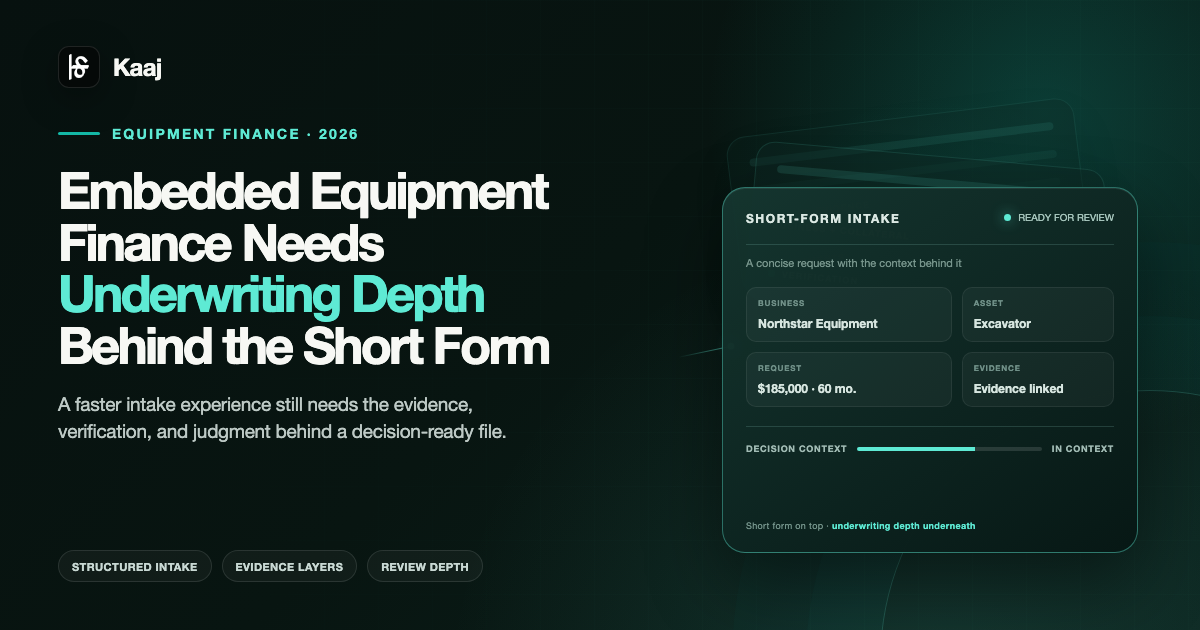
Table of contents
About the author
Shivi SharmaCredit and fraud risk operator with experience across American Express, Varo Bank, and Uber.
In short: a fast embedded application does not eliminate underwriting work; it relocates it to the minutes after submission. Equipment finance teams still need business verification, bank statement review, fraud signals, missing-document checks, and a structured credit file ready for human review behind the short form.
A strong vendor finance experience often starts with a simple moment: a buyer is at the dealer quote desk, evaluating a piece of equipment, and wants to understand whether financing is realistic before the deal loses momentum.
The front-end expectation is clear. The application should be short. The response should be fast. The buyer should not feel like they have been handed off into a disconnected lending process. Dealers and vendors want financing to feel like part of the equipment sale, not a separate administrative detour.
But the short form does not make underwriting work disappear. It moves the work behind the scenes.
For embedded equipment finance to work, the lender still needs a reliable view of the borrower, the business, the equipment request, available financial evidence, potential fraud signals, bank activity, policy fit, and open stipulations. The difference is that this preparation has to happen earlier, faster, and with less room for back-and-forth confusion.
That is the operational tension inside embedded finance: the buyer sees a streamlined experience, while the credit team still needs a complete enough file to make a sound decision.
The short form moves the bottleneck downstream
Vendor and dealer finance programs are being pushed toward faster point-of-sale experiences. Buyers are used to digital applications in other parts of their financial lives. Dealers want to protect sales momentum. Brokers and finance partners want cleaner submissions. Lenders want to compete for vendor share without weakening credit discipline.
In that environment, the short-form application becomes the visible promise of speed.
It may collect only the essentials: business name, owner information, requested equipment, time in business, estimated revenue, contact details, and authorization for additional checks. That is useful. It removes friction at the point of sale and gives the vendor a better chance of keeping the buyer engaged.
But a short form is not the same as a decision-ready borrower package.
Once the application arrives, someone still has to answer practical questions:
- Is the business entity valid and active?
- Do the owners and guarantors match the submitted information?
- Are there inconsistencies between the application, documents, bank activity, and public business records?
- Does bank activity support the borrower’s stated operating profile?
- Are there deposits, transfers, overdrafts, negative days, or unusual patterns that need review?
- Does the requested equipment match the business use case?
- Which stipulations are actually needed before a credit decision or funding step?
- What should be summarized for the underwriter, and what should be escalated?
When those questions are answered manually, the point-of-sale speed can quickly turn into back-office drag. The vendor sees a delay. The buyer sees uncertainty. The credit team receives another partial file that needs reconstruction before judgment can begin.
The first delay is usually not the credit decision
In many vendor finance workflows, the early delay is not caused by a difficult final credit call. It is caused by preparation.
A file may sit while documents are renamed, split, sorted, or re-requested. Application data may need to be rekeyed into multiple systems. Business verification may require separate searches. Bank statements may need line-by-line review. Stipulations may be discussed across email, chat, and spreadsheets. A credit memo may be drafted only after the analyst has already spent time assembling the evidence.
That work matters. It protects the lender and gives the underwriter context. The issue is not that the work exists. The issue is that embedded finance compresses the time available to do it.
At the dealer quote desk, a buyer may expect a near-immediate indication. The vendor may be comparing finance partners based on who can respond clearly and consistently. A broker may be trying to package the deal cleanly enough that it does not get bounced back. A credit team may be managing a queue that includes clean applications, thin files, exceptions, fraud concerns, and incomplete submissions all at once.
The operational question is no longer simply, “Can we underwrite this borrower?”
It becomes, “Can we prepare the borrower file quickly enough that the underwriting team can do real credit work while the transaction is still active?”
Vendor finance creates pressure in specific places
Embedded equipment finance is not just a faster application form. It changes where pressure shows up in the workflow.
Dealers feel it in buyer confidence. If the finance path is unclear, the buyer may pause the equipment decision. Even when the lender is still working responsibly, silence can feel like friction at the sales counter.
Vendor finance teams feel it in submission quality. A high-volume vendor channel can generate files with uneven completeness. Some borrowers provide clean documents. Others submit screenshots, partial statements, outdated entity information, or inconsistent owner details.
Credit analysts feel it in context switching. The analyst may need to move between the application, documents, bank data, business verification sites, internal policy, prior notes, and communication threads before writing a useful recommendation.
Credit leaders feel it in policy consistency. When speed pressure rises, teams need to know whether files are being evaluated against the same evidence standard. Fast does not help if different people interpret missing information or exceptions differently.
Borrowers feel it in stipulations. A vague or shifting stip list can make the process feel unpredictable. A clear stip request, based on actual file gaps, is easier for the vendor and borrower to act on.
This is why embedded finance requires more than a polished front end. The intake and preparation layer has to be strong enough to absorb the complexity that the short form hides.
Where embedded finance workflows typically stall
| Visible symptom | What is happening | Where preparation should catch it |
|---|---|---|
| Buyer loses momentum at the quote desk | The file waits on manual document sorting or re-keying | Intake and field extraction before the file queues |
| Underwriter asks for information already submitted | Data was not structured or reconciled across sources | Business verification and document comparison at intake |
| The stipulation list changes repeatedly | Gaps were found late instead of upfront | Missing-document identification before credit review |
| Similar files receive inconsistent preparation | No shared evidence standard was applied at intake | Structured statement analysis and fraud-signal review |
Related guidance: structured intake and vendor payment certainty, faster business verification for equipment finance, and why fraud checks should happen before credit analysis.
The old workflow breaks when exceptions rise
Traditional workflows can function when volume is steady, files are familiar, and exceptions are limited. A small team can manually sort documents, check business records, review statements, and prepare notes for credit.
The strain appears when the channel grows or the mix changes.
A vendor program may start receiving more applications from newer businesses, seasonal operators, multi-entity ownership structures, or borrowers with inconsistent document quality. Equipment requests may range from straightforward replacement assets to larger growth purchases. Some files may include complete bank statements, while others require follow-up. Some businesses may have clean entity records, while others have name variations, address mismatches, or ownership questions.
Under those conditions, manual preparation becomes difficult to scale because every exception creates a new branch in the workflow.
One file needs business verification. Another needs bank activity classified. Another needs a missing statement. Another needs an ownership discrepancy reviewed. Another needs a fraud signal surfaced for human review. Another needs a memo drafted from several sources that do not line up neatly.
If the team relies on manual handoffs, the process can become dependent on individual memory: who checked what, which exception matters, which stip was already requested, and whether the underwriter has the latest version of the file.
Embedded finance magnifies those gaps because the dealer-facing experience has already set an expectation of speed.
Underwriting depth has to move upstream
The practical answer is not to make the short form longer until it resembles a traditional application package. That would undermine the vendor experience.
The better approach is to move underwriting preparation upstream.
That means the lending team should be able to receive a short-form application and rapidly build a structured view of the borrower file behind it. The goal is not to turn every application into an automatic approval. The goal is to make the file ready for human credit review sooner.
A strong preparation layer should help the team:
- Intake documents from the vendor, borrower, broker, or internal portal.
- Extract key fields from applications, statements, IDs, invoices, and supporting documents.
- Compare submitted information against business verification sources.
- Review bank statement activity for cash flow, balances, negative days, deposits, transfers, and patterns that merit attention.
- Surface potential fraud signals or inconsistencies for human review.
- Identify missing or stale documents before the file reaches the underwriter.
- Prepare a credit memo that organizes the relevant evidence and open questions.
- Flag files for routing based on completeness, exception type, or policy requirements, with a human making the final call.
This is the layer that connects a fast vendor experience to a credit process that still has depth.
Where AI agents help in the embedded finance workflow
AI agents are most useful in this context when they handle preparation work that is repetitive, evidence-heavy, and time-sensitive.
In an embedded equipment finance workflow, that can include document intake, extraction, KYB, bank statement analysis, fraud signals, and credit memo preparation. Instead of forcing analysts to manually assemble the same categories of evidence file after file, agents can help structure the information and surface what needs attention.
For example, an intake agent can organize borrower documents and identify what appears to be missing. An extraction workflow can pull key fields from applications and statements. KYB workflows can help verify business information and flag mismatches. Bank statement analysis can summarize activity that the credit team needs to review. Fraud signal checks can surface inconsistencies without treating those signals as final conclusions. A memo preparation workflow can assemble the evidence into a format that supports faster human review.
Kaaj helps lending teams prepare decision-ready borrower packages and supports human-in-the-loop underwriting workflows. For vendor finance teams, the important distinction is that this is preparation infrastructure. It helps organize evidence, reconcile inputs, and surface exceptions so credit teams can focus on judgment, policy interpretation, structure, and final decision-making.
That distinction matters. Embedded finance should not hide risk behind a fast interface. It should make the relevant evidence available earlier, in a cleaner format, with the right exceptions visible to the people responsible for the credit call.
What should remain human-owned
The more embedded the finance experience becomes, the more important it is to define which parts of the workflow belong to people.
Final credit judgment should remain with the lender’s credit team. So should policy exceptions, structure decisions, pricing considerations, documentation requirements, and relationship-sensitive calls. Human reviewers should decide how to interpret unusual bank activity, whether an inconsistency is explainable, whether a stipulation is necessary, and how the equipment request fits the borrower’s business.
AI-supported preparation can improve the quality and speed of the file that reaches the reviewer, but it should not blur accountability.
A useful operating model separates the work clearly:
- Machines help gather, classify, compare, and summarize evidence.
- Workflow logic helps route files and highlight missing information.
- Credit teams review the evidence, resolve exceptions, apply policy, and make the decision.
That separation is especially important in vendor finance because the front end may be optimized for simplicity. The borrower may only see a short application and a fast response path. Internally, the lender still needs a defensible process that documents what was reviewed and why the file moved forward, required follow-up, or stopped.
The intake layer is now a competitive layer
Rate is rarely the only factor in vendor share. Dealers and vendors also weigh which finance partner responds clearly, keeps stipulations stable, and helps preserve momentum with the buyer.
That makes the intake layer a competitive part of the vendor finance model.
If intake is weak, the program may create a good first impression and then lose credibility during follow-up. If intake is strong, the lender can give the vendor a cleaner view of where the file stands: what is complete, what is missing, what needs human review, and what the next step should be.
For leaders reviewing an embedded equipment finance program, the useful questions are operational:
- What information does the short form collect, and what evidence must be gathered after submission?
- How quickly can the team verify the business and organize owner information?
- How are bank statements received, analyzed, and summarized?
- Where are potential fraud signals surfaced, and who reviews them?
- How are missing documents and stipulations communicated back to the vendor or borrower?
- Is the credit memo built from structured evidence or recreated manually each time?
- Can the team see why a file is delayed, or does the delay live inside inboxes and side conversations?
- Are exceptions routed consistently, or do they depend on who happens to touch the file first?
These questions are not abstract technology questions. They determine whether the fast front-end promise can survive contact with real underwriting work.
The short form is only the beginning
Embedded equipment finance will keep pushing more of the lending experience toward the point of sale. That is good for dealers, vendors, and borrowers when it reduces unnecessary friction. But the lending process still has to support credit depth, fraud awareness, consistent documentation, and human judgment.
The short form starts the conversation. The intake layer determines whether the lender can turn that conversation into a prepared file quickly enough to matter.
For vendor finance teams, the priority is not to choose between speed and underwriting discipline. It is to design the workflow so that speed at the front end is matched by structured preparation behind it.
Review the intake layer behind vendor finance speed.
Ready to see Kaaj in action?
Book a demo and walk through a live deal with our team — from intake to credit memo.
Book a demo