
Where AI Stops and Underwriter Judgment Starts
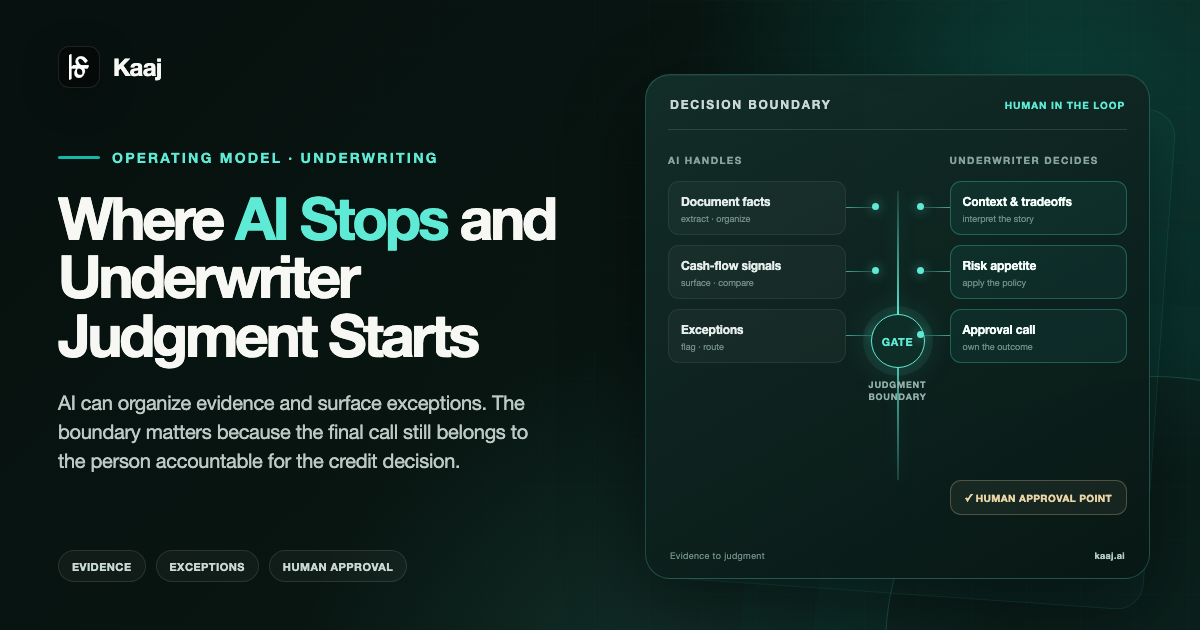
Table of contents
About the author
Shivi SharmaCredit and fraud risk operator with experience across American Express, Varo Bank, and Uber.
The short answer: AI should own preparation; humans should own authority. AI can organize borrower documents, extract and reconcile data, flag inconsistencies, and draft evidence-linked memo content. Underwriters and credit leaders decide what the evidence means, which exceptions are acceptable, and what gets approved. A decision-ready package is not a decision.
Equipment finance teams do not need another vague promise that AI will automate underwriting. They need a clear operating boundary.
That boundary matters because credit work is under pressure from both sides. Borrowers and brokers expect faster responses. Lenders are managing cautious growth, tighter credit, flexible structures, digital-fraud pressure, and more complex business-identity questions. Executives are interested in workflow modernization, but credit leaders are right to be skeptical of any system that implies it can replace judgment.
The practical answer is not autonomous lending. It is human-in-the-loop AI: AI prepares the file, organizes the evidence, reconciles inputs, and surfaces exceptions. Human underwriters and credit authorities decide what the evidence means.
That distinction is where trust starts.
The useful boundary: AI prepares, humans decide
In equipment finance, the most valuable AI boundary is not between manual and automated work. It is between preparation and authority.
Preparation includes the work that happens before an underwriter can make a useful judgment: collecting borrower documents, classifying files, extracting fields, comparing names and addresses, reviewing bank activity, identifying inconsistencies, assembling fraud signals, and drafting a credit memo that points back to the supporting evidence.
Authority includes the judgment that determines whether a borrower, structure, collateral position, guarantor profile, pricing approach, or policy exception is acceptable for the lender. That responsibility should remain with the credit team.
A decision-ready borrower package is not the same as a decision. It is a better starting point for one.
This is the most important distinction for executives evaluating agentic AI in credit analysis. The right system should make underwriters more prepared, not less accountable. It should reduce time spent searching, copying, checking, and rechecking. It should not obscure who made the credit call, why the call was made, or which exceptions were accepted.
The market signal is workflow pressure, not AI hype
The strongest market signal is operational. Lenders and brokers are trying to move faster while protecting credit quality. Independent lessors are competing on execution, specialization, and responsiveness. Brokers are educating borrowers through a more complex financing environment. Credit teams are dealing with more verification steps, more document variation, and more pressure to explain decisions clearly.
At the same time, digital-fraud pressure has made business identity and document review more important in origination. Identity checks, KYB review, bank statement analysis, and document consistency are no longer back-office housekeeping. They shape the quality of the credit conversation.
This is why many AI pilots disappoint. They start with a model or feature instead of a workflow. A lender adds automation to one task, but the file still moves through inboxes, spreadsheets, portals, bank-statement tools, identity checks, and memo templates. The underwriter still has to reconcile the answer manually.
For credit leaders, the better question is specific: where does the file get stuck before judgment can happen?
Where the old file path breaks
A typical equipment finance file may include an application, broker notes, invoice or equipment description, bank statements, business documents, ownership information, IDs, tax returns or financial statements, and email context about structure or timing. Those materials often arrive in pieces, across multiple channels, and in inconsistent formats.
The first pain usually appears before formal underwriting. Intake teams, credit analysts, broker coordinators, and underwriters spend time answering basic questions:
- Are all required documents present for this transaction type?
- Does the legal business name match the application, bank account, and public records?
- Are there alternate names, DBAs, address changes, or ownership changes that need review?
- Do deposits and balances in the bank statements support the borrower story?
- Are there unusual transactions, returned items, negative balances, or cash-flow patterns that need explanation?
- Does the invoice match the requested equipment, vendor, amount, and structure?
- Which policy exceptions are already visible before the underwriter opens the memo?
- Which facts came from documents, and which came from email or broker notes?
When volume rises, this workflow breaks in predictable ways. Missing documents are discovered late. A business-name mismatch sits in an email thread instead of the credit memo. A bank statement observation is copied into a spreadsheet but not tied to the source. A fraud signal is noted by one reviewer but not visible to the next person. A policy exception is discussed informally, then has to be reconstructed for approval.
None of this is a failure of underwriting skill. It is a workflow design problem. Scarce credit judgment is being spent on file assembly.
Where AI belongs: evidence preparation and exception routing
This is where AI can be useful without crossing the line into autonomous judgment.
In a human-in-the-loop workflow, AI agents can help automate document intake, extraction, KYB, bank statement analysis, fraud signals, and credit memo preparation. The operational value is not that AI decides whether to fund the deal. The value is that the underwriter receives a clearer file, with the right issues already organized for review.
Three examples show the boundary.
1. Exception summary
Instead of forcing a reviewer to search through every document and email, AI can prepare an exception summary. That summary might flag missing documents, mismatched business names, inconsistent addresses, unusual bank activity, stale financial information, or a policy item that needs human review.
The underwriter still determines significance. A mismatch may be a harmless DBA issue, a data-entry problem, or a reason to pause the file. AI should surface the issue and point to the evidence. The human decides what it means.
2. Evidence-backed memo
A credit memo is only useful if the reviewer can trust where the facts came from. AI can help draft memo sections from extracted and reconciled information: borrower overview, ownership details, bank statement observations, KYB results, collateral notes, fraud signals, and open conditions.
The underwriter should be able to edit the memo, add context, accept or reject observations, and document rationale. The memo should not become a black box. It should become a structured record of evidence and review.
3. Underwriter approval path
AI can also help route work to the right human checkpoint. If the file has a clean document set but a cash-flow concern, it should be queued differently than a file with unresolved identity questions. If a policy exception is visible, the package should make that exception easy to review and escalate.
This is especially important for executives managing distributed teams, broker channels, or multi-step approval processes. The goal is not to remove the approval path. The goal is to make the path explicit.
What should remain human-owned
The more capable AI becomes at preparation, the more important it is to define what remains human-owned.
Underwriters and credit leaders should retain authority over credit policy interpretation, risk appetite, structure, pricing considerations, collateral concerns, guarantor support, industry context, relationship context, exception approval, and final recommendations or decisions.
AI can identify that bank deposits are uneven. A human decides whether seasonality, contract timing, or borrower explanation changes the credit view.
AI can surface a business-identity inconsistency. A human decides whether additional verification is required and how the issue affects the file.
AI can note that a requested structure appears outside a standard policy path. A human decides whether the exception is acceptable, who must approve it, and how the rationale should be documented.
AI can prepare a memo. A human owns the recommendation.
This boundary also protects accountability. Credit teams need to know who reviewed the exception, who accepted the explanation, who changed the memo, and who approved the next step. Human-in-the-loop AI only works when the loop is visible.
AI-owned vs. human-owned: the working boundary
| AI prepares | Human decides |
|---|---|
| Document intake, classification, and extraction | Whether the evidence is complete and reliable |
| Business verification and KYB checks | Whether an identity inconsistency requires escalation |
| Bank statement analysis and pattern flags | Whether a cash-flow pattern is explainable or disqualifying |
| Fraud signals | Whether a signal changes the credit view |
| Draft memo content tied to source evidence | Policy interpretation, structure, pricing, and recommendation |
| Files flagged for the appropriate review checkpoint | Exception approval and accountability for the decision |
For adjacent operating guidance, see the speed-versus-judgment tradeoff, the AI readiness checklist, and how underwriting systems evolve as lending scales.
Trust comes from review design
Trust in AI is not created by a better demo. It is created by review design.
For equipment finance teams, that means the workflow should answer several operational questions:
- What did the system extract from the borrower package?
- Which source documents support the extracted fields?
- What did the system reconcile across documents and systems?
- Which exceptions were surfaced for review?
- Which findings were accepted, edited, rejected, or escalated by a human?
- What changed between the first prepared package and the final credit memo?
- Who had authority at each checkpoint?
These questions matter because credit work is collaborative. A broker may provide additional context. An analyst may clear a document issue. An underwriter may add risk commentary. A credit manager may approve an exception. A funder may need conditions satisfied before closing.
If AI preparation is detached from that workflow, it becomes another tool to check. If it is built into the review path, it can reduce friction without weakening control.
This is the difference between generic automation and workflow modernization. Generic automation completes a task. Workflow modernization makes the next decision easier, better documented, and easier to review.
The executive test: does AI improve the file before judgment?
Executives do not need to evaluate AI with abstract questions about intelligence. They can evaluate it with file-level questions.
Before AI, how does a borrower package arrive to credit? How much time is spent finding missing items, reconciling inconsistent data, and preparing the memo? Where do exceptions live? How are fraud signals documented? How often does an underwriter need to reopen the source documents to confirm basic facts? How easy is it to see the path from intake to recommendation?
After AI, the standard should be practical. The file should arrive cleaner. The open questions should be clearer. The evidence should be easier to inspect. The memo should be easier to complete. The approval path should be easier to follow. The human credit authority should be unchanged.
That is where AI stops and underwriter judgment starts.
AI earns trust when it prepares the work underwriters already need to do: document intake, extraction, KYB review, bank statement analysis, fraud-signal organization, exception summaries, audit trails, and credit memo preparation. It loses trust when it implies that judgment can be outsourced.
For lenders and brokers modernizing credit analysis, the goal is not to automate accountability away. The goal is to give accountable people better-prepared files, clearer evidence, and explicit review paths.
See human-in-the-loop credit preparation in Kaaj.
Ready to see Kaaj in action?
Book a demo and walk through a live deal with our team — from intake to credit memo.
Book a demo