
Why Vendor Payment Certainty Starts with Structured Intake
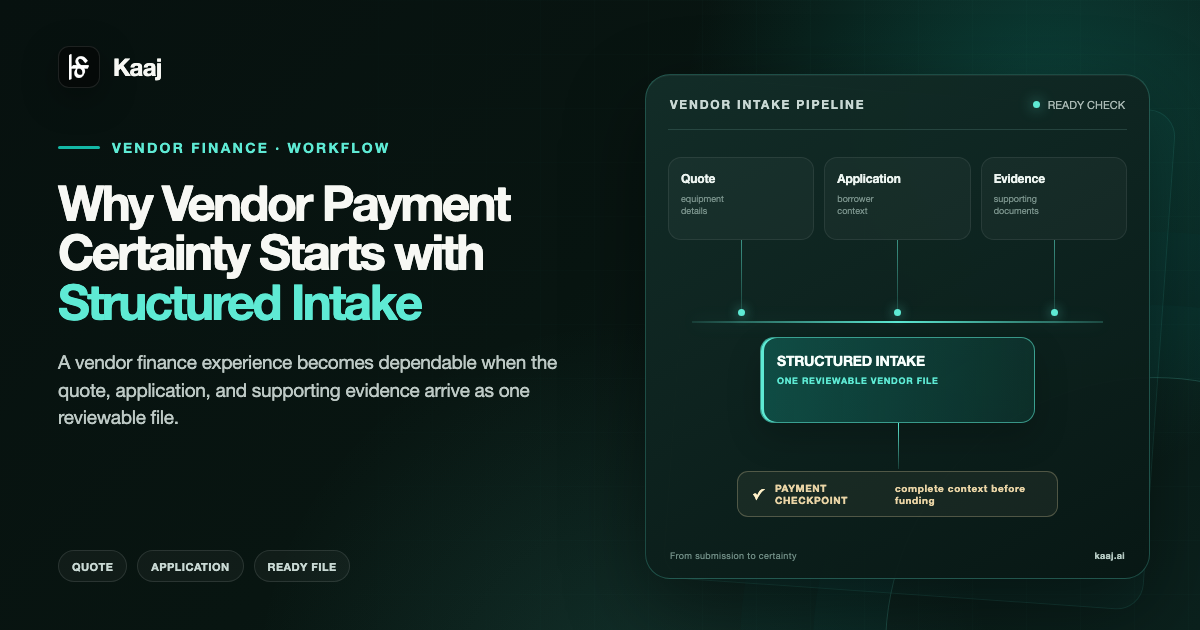
Table of contents
About the author
Utsav ShahAI and decision-systems operator with experience building large-scale systems at Uber and Cruise.
Vendor payment certainty depends on structured intake, not a faster form. A short-form application collects enough data to start a deal, but not enough to underwrite one. Structured intake connects the quote, application, documents, business-verification evidence, bank statements, and stipulations before a credit analyst opens the file.
A vendor finance experience starts before a credit analyst sees a complete file. It starts at a vendor checkout, a dealer quote desk, or a short-form application where the buyer wants a usable payment path while the equipment decision is still live.
That front-end moment is getting faster. Buyers expect a financing process that matches the pace of the sales conversation. Vendors want finance partners who can keep a deal moving without turning every quote into a document chase. Brokers and lenders are being asked for cleaner submissions, faster responses, and fewer late surprises, especially when rate expectations, tax-driven buying cycles, and competitive dealer timelines compress the window to act.
The pressure is not only a sales problem. It lands in underwriting operations. A fast point-of-sale experience creates an expectation that the back office can match it. If intake is still built around email attachments, manual rekeying, tab-by-tab business verification, and late stip discovery, the borrower experience can feel fast at the start and slow when it matters most.
Embedded equipment finance only works if underwriting preparation can keep up behind the point-of-sale experience.
For the broader point-of-sale pattern, see why embedded equipment finance needs underwriting depth behind the short form. For the evidence layer, see bank statement analysis for lenders and business verification.
The vendor feels the gap first
In dealer financing, the vendor often becomes the first person to absorb underwriting friction. The buyer has already chosen equipment or narrowed the purchase. The vendor has provided a quote, estimated payments, and set delivery expectations. Then the finance process asks for more documents, a corrected legal name, ownership information, bank statements, or clarification on a business address.
None of those requests may be unreasonable. In many cases, they are basic credit and compliance inputs. The issue is timing and visibility.
When missing items surface late, the vendor hears the frustration first. The broker or originator has to explain why a file that looked simple is now on hold. The analyst receives a package that may contain useful evidence, but not in a form that is easy to trust. Operations staff spend time matching attachments to requirements instead of advancing the deal.
That is typically where payment certainty starts to break down. Certainty does not mean every borrower receives the same answer or that every application moves forward. It means the parties can see what is known, what is missing, and what needs human review early enough to keep the conversation stable.
A short application is not a complete credit file
Embedded workflows often begin with a short form because that is what the sales moment can support. A buyer can enter company information, requested amount, equipment type, and contact details quickly. That creates a smoother borrower experience, but it does not eliminate the work behind the file.
The lender still needs to understand the applicant entity, ownership or guarantor structure where required, the equipment being financed, financial capacity, bank activity, document authenticity, and policy fit. Those inputs may arrive as PDFs, images, spreadsheets, bank statements, vendor quotes, invoices, tax documents, IDs, or emails forwarded from multiple people.
If those items enter the workflow as loose attachments, underwriting prep becomes reconstruction. Teams must decide which file is current, whether the legal name matches the application, whether a bank statement covers the requested period, whether the quote aligns with the equipment described, and whether any obvious inconsistencies require escalation.
The old workflow can handle this when volume is low and every deal is relationship-managed from the beginning. It breaks under embedded volume because the front end produces more applications, more partial files, and more exceptions before credit has enough structure to evaluate them efficiently.
Structured intake turns speed into usable evidence
For vendor finance, structured intake is the operating layer between the sales moment and credit review. It does not replace underwriting judgment. It prepares the evidence so judgment can happen on a complete, organized package.
A structured intake layer should be able to:
- Capture application data in the lender's required format, not just in the vendor's sales format.
- Tie the equipment quote, invoice, or description to the borrower request.
- Classify incoming documents and identify missing pages, expired items, or incorrect file types.
- Extract key fields from borrower documents and bank statements for review.
- Run KYB business verification checks and surface mismatches in legal name, address, entity status, or ownership data when available.
- Surface fraud signals and document inconsistencies without treating every flag as a final conclusion.
- Track open stipulations in a way the originator, broker, vendor, and credit team can understand.
- Prepare a lender-ready package and credit memo draft for human review.
The point is not to make the application feel automated for its own sake. The point is to turn a fast start into a reliable handoff. A dealer quote desk should not have to guess whether the finance package behind the payment estimate is complete enough for credit review. A credit analyst should not have to start by sorting through a folder of unstructured attachments.
The real bottleneck is exception handling
Clean files are not the only test of an embedded finance workflow. The larger test is what happens when a file is almost clean.
The business name may be entered as a DBA while bank statements show the legal entity. A guarantor may be listed, but ownership documentation may be incomplete. The vendor quote may be updated after the original application. Bank activity may include transfers, cash deposits, seasonal revenue, or NSF activity that needs context rather than an automatic conclusion. A document may be legible enough for a person but not clearly tied to the right entity or period.
In a manual workflow, these exceptions often become queues, email threads, and duplicate follow-ups. One person knows why the quote changed. Another person knows the borrower sent a corrected statement. A third person is waiting to confirm whether an entity mismatch is material. The file moves, but the reasoning does not always move with it.
That is why underwriting speed depends on more than faster forms. It depends on whether the intake layer can separate routine preparation from exception review. Clean evidence should move forward. Gaps should be visible. Ambiguities should be routed to the right human owner with enough context to act.
Where AI agents help in a human-in-the-loop workflow
AI agents are useful in embedded equipment finance when they prepare evidence, reconcile inputs, and surface exceptions for credit teams. They are not useful when they are positioned as a substitute for lender policy or credit judgment.
Kaaj helps lending teams prepare decision-ready borrower packages. In a human-in-the-loop underwriting workflow, Kaaj helps automate document intake, extraction, KYB, bank statement analysis, fraud signals, and credit memo preparation. That means the system can support the work that happens before a credit decision: collecting materials, organizing evidence, highlighting inconsistencies, and preparing a reviewable package.
In practice, that can look like several connected workstreams:
- Document intake: classify incoming files, connect them to the application, identify missing or inconsistent items, and reduce manual sorting.
- KYB business verification: compare borrower-provided information against business verification inputs and flag mismatches for review.
- Bank statement analysis: extract activity, normalize statement periods, and surface patterns that may need analyst attention.
- Fraud signals: identify inconsistencies across application data, documents, bank information, and business verification results for human escalation.
- Credit memo preparation: organize extracted facts, open items, and relevant evidence into a memo draft the credit team can review, edit, and own.
- Workflow routing: send clean packages, incomplete files, and exception-heavy files down different paths instead of treating every submission the same way.
This is preparation work. Kaaj structures and prepares the file through the decision-ready stage; the lender owns the credit decision and payment authorization.
| Workflow stage | What the state means | Primary owner |
|---|---|---|
| Submitted | The application and available materials have entered intake | Originator, vendor, or operations |
| Incomplete | A required document, period, page, or field is missing | Operations coordinates follow-up |
| Verified | Available identity and business-verification evidence has been organized for review | Operations or the lender's designated reviewer |
| Exception | A mismatch, ambiguity, or risk signal needs human interpretation | The lender's designated exception owner |
| Decision-ready | Evidence, gaps, and open questions are organized for credit review | Kaaj supports preparation; credit accepts the handoff |
| Lender decision | Credit authority evaluates the transaction under policy and risk appetite | The lender |
| Payment authorized | The lender has completed the approvals required to release funds | The lender |
Payment certainty is a team outcome
Payment certainty is often discussed as a front-end borrower experience problem, but it is really a team outcome. Sales needs a finance path that does not undermine the equipment sale. Brokers need to submit cleaner packages with fewer preventable follow-ups. Credit needs files that are organized enough to review consistently. Operations needs to know which missing items matter now and which can be collected later. Leadership needs visibility into where deals slow down and why.
When intake is unstructured, each group optimizes locally. Sales pushes the application forward. Operations asks for documents. Credit waits for clarification. The vendor tries to protect the customer relationship. The result can be repeated borrower asks, changing stip expectations, and slower movement at exactly the point where the buyer expects clarity.
When intake is structured, the workflow becomes easier to govern. The application, equipment information, borrower documents, KYB checks, bank analysis, fraud signals, and memo preparation all connect to the same file. The lender can still apply its own policy, appetite, and judgment, but the package arrives in a form that supports review rather than reconstruction.
For a vendor or dealer, that distinction matters. A lower rate rarely overcomes a process that introduces late conditions, duplicate document requests, or unclear next steps. Finance partners that can move quickly with stable stip visibility are better positioned to keep the sale moving.
What to inspect before adding more front-end speed
Many lenders and brokers focus first on the visible part of embedded finance: the application form, dealer portal, payment calculator, or prequalification experience. Those matter. But if the intake layer behind them is not ready, each improvement at the front end can create more pressure downstream.
Before adding another faster entry point, lenders should inspect the workflow behind it:
| Intake signal | Structured | Unstructured |
|---|---|---|
| Vendor quote tied to application | Travels with the file and stays current | Reconfirmed manually and can drift from the request |
| Legal name, DBA, and ownership | Captured once and checked against business-verification evidence | Reconciled by hand when mismatches surface late |
| Incoming documents | Classified and checked before analyst review | Sorted manually and gaps appear mid-review |
| Bank statements | Normalized with exceptions surfaced | Read individually with inconsistent review paths |
| Clean and exception files | Flagged for different review paths | Treated alike, so clean files wait behind exceptions |
If the answer is no, the embedded experience may be faster than the underwriting preparation layer. That gap is where borrower confidence erodes and vendor relationships feel the strain.
The operational takeaway
Vendor payment certainty starts with structured intake because the finance promise made at the point of sale has to survive credit preparation. Faster applications and dealer portals can create demand, but they do not by themselves create a decision-ready file.
The strongest embedded and dealer financing workflows connect the front-end borrower experience to deeper underwriting preparation. They capture the sales context, organize documents, verify business information, analyze bank activity, surface fraud signals, route exceptions, and prepare a credit memo for human review. Credit teams remain responsible for the judgment that follows.
That is the practical layer to examine as vendor finance becomes more competitive. Review the intake layer behind vendor finance speed.
Ready to see Kaaj in action?
Book a demo and walk through a live deal with our team — from intake to credit memo.
Book a demo