
The 2027 Planning Question: Which Prep Work Should Underwriters Stop Doing?
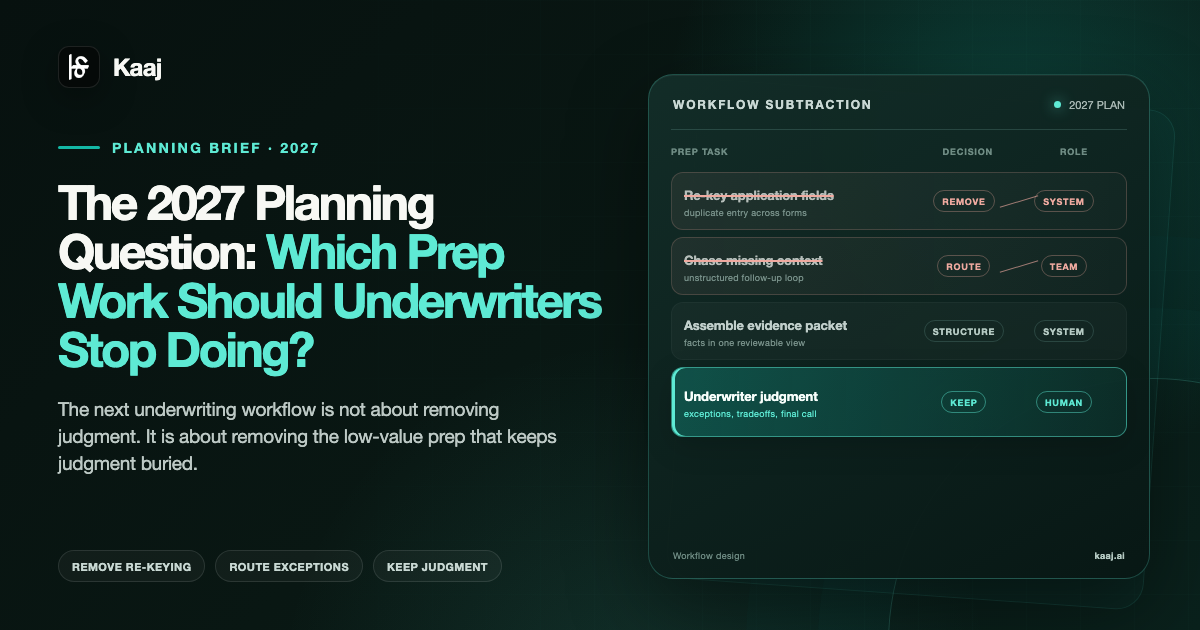
Table of contents
About the author
Utsav ShahAI and decision-systems operator with experience building large-scale systems at Uber and Cruise.
In short: Underwriters should stop owning five preparation tasks that a governed AI workflow can prepare instead: file organization at intake, re-keying clean borrower data, late discovery of missing documents, first-pass bank statement views, and repetitive memo background. Credit teams should keep owning risk appetite, exception materiality, structure, conditions, and final approval.
A common but weak AI pilot target is to make underwriting faster. A more useful planning question is narrower: which preparation work should underwriters stop doing?
That distinction matters for 2027 planning. Lending teams do not need another abstract AI initiative that sits outside the way deals actually move. They need workflow modernization that reduces low-judgment preparation, preserves human credit ownership, and makes exceptions easier to see before a file reaches final review.
For equipment finance lenders, brokers, and credit teams, the highest-value AI readiness work is not model selection first. It is operating model design: inputs, exception paths, review roles, and audit logs. Once those are clear, lender automation can support better package preparation without asking credit teams to give up judgment.
The market signal is operational, not theoretical
After a challenging macro backdrop, lenders are planning more cautiously. Growth still matters, but teams are being asked to add capacity without adding uncontrolled risk or unnecessary fixed cost. At the same time, vendors across origination, document processing, verification, and LOS integration are pushing more automation into the front end of lending workflows.
That creates pressure on operations leaders. If competitors can intake, organize, and review borrower information faster, a manual workflow becomes a constraint. But if AI is dropped into an unclear process, it can create a second problem: faster movement of incomplete or poorly governed files.
The practical takeaway is simple. AI readiness is not just a technology question. It is a workflow question. Before scaling agentic AI in underwriting operations, leaders need to decide what work should be prepared by systems, what should be routed for review, and what must remain owned by underwriters and credit approvers.
Prep work is where the bottleneck hides
Underwriting teams often describe the pain as slow credit review. In practice, the delay frequently starts earlier.
A borrower package may arrive through email, a broker portal, a CRM note, a LOS task, or shared storage. Documents may be missing, duplicated, mislabeled, stale, or inconsistent. Entity names may not match across the application, bank statements, invoices, formation documents, and guarantor information. Bank statements may require manual spreading before an analyst can form a view. Fraud signals may be buried inside document metadata, formatting issues, or inconsistent submitted information.
None of this is final credit judgment. It is preparation for judgment.
The people who feel the pain first are usually operations coordinators, credit analysts, sales support teams, and underwriters who become the fallback document quarterback. They chase missing items, rename files, re-key borrower information, compare versions, summarize basic facts, and build first-pass memo language before the real credit question is ready for review.
That is the prep work worth challenging in 2027 planning.
Why the old workflow breaks under pressure
The old workflow can function when volume is steady, document sets are simple, and exceptions are rare. It breaks when volume rises, broker submissions vary, staffing is tight, or credit policy becomes more nuanced.
The issue is not that underwriters lack discipline. The issue is that the workflow asks skilled people to do unskilled and semi-skilled preparation before they can apply judgment. Each file requires manual triage. Each exception is discovered at a different moment. Each handoff depends on notes, inbox history, or institutional memory.
As exceptions accumulate, the team loses a clean view of file readiness. A missing bank statement, an inconsistent legal name, an unusual deposit pattern, and a policy boundary question may all sit in the same queue. The result is slower turnaround and more context switching, even when the credit team is working hard.
AI pilots underperform in this environment when they automate a task without redesigning the route around it. A document extraction tool is useful only if extracted fields flow into a reviewable package. A bank statement analysis workflow is useful only if exceptions are labeled and routed. A credit memo draft is useful only if it points back to the evidence a human reviewer can evaluate.
The readiness test: repeatable, evidence-based, reviewable
Not every underwriting task is ready for AI assistance. A practical readiness test is whether the work is repeatable, evidence-based, and reviewable.
A task is a strong candidate for AI-assisted preparation when:
- The required inputs are known.
- The output can be tied to source documents.
- Common exceptions can be named in advance.
- A human reviewer can approve, correct, or override the output.
- The review action can be logged for later quality review.
A task is a poor candidate when it depends primarily on risk appetite, judgment under uncertainty, relationship context, unusual collateral facts, or final approval authority. Those areas should remain human-owned.
This is the line lending leaders should draw clearly. AI can help prepare the evidence. Credit teams remain in control of final decisions.
Start with one scoped pilot, not the whole underwriting department
The best AI readiness pilot is narrow enough to govern and real enough to matter. For example, a lending operations team might choose one channel, one product type, or one common borrower package pattern. The goal is not to transform every workflow at once. The goal is to prove that a defined file path can move from messy intake to decision-ready package preparation with human review at the right points.
A scoped pilot should define:
- Where the file enters the workflow: email, CRM, LOS, portal, or storage.
- Which documents are expected at intake.
- Which fields should be extracted and compared.
- Which bank statement items should be prepared for analyst review.
- Which KYB checks and fraud signals should be surfaced.
- Which exceptions stop the file, route it to operations, or escalate it to credit.
- Which memo sections can be drafted from source evidence.
- Which reviewer actions must be captured in an audit trail.
This is also where LOS integration and surrounding workflow design matter. The pilot should not require a rip-and-replace mindset. Kaaj can fit alongside existing CRM, LOS, email, and storage workflows, which allows teams to test preparation and routing without redefining every system of record on day one.
Build an exception taxonomy before you scale
Exception design is the difference between useful automation and faster confusion.
A lender should define exception categories before running a pilot. Common categories may include missing documents, stale documents, entity-name mismatches, ownership or guarantor ambiguity, bank statement gaps, unusual transaction patterns that require review, document-quality concerns, invoice or equipment-description inconsistencies, and policy boundary conditions.
Each category should have a route. Some exceptions belong with operations because the next action is a document chase. Some belong with an analyst because the next action is evidence review. Some belong with an underwriter because the issue may affect structure, conditions, or credit appetite. Some legal or compliance questions should be routed to the appropriate internal or external specialists.
The point is not to make AI decide the outcome. The point is to keep exceptions from hiding inside a general work queue.
Where agentic AI helps in underwriting operations
In a human-in-the-loop underwriting workflow, AI agents can support preparation across several parts of the file. They can help ingest documents, classify them, extract key fields, compare borrower information across sources, support KYB workflows, prepare bank statement analysis, surface fraud signals, and assemble a first-pass credit memo from available evidence.
That work is valuable because it changes what the underwriter receives. Instead of a folder of mixed documents and scattered notes, the reviewer sees a borrower package organized around evidence, open questions, and exceptions.
Kaaj helps lending teams prepare decision-ready borrower packages in this way. It supports human-in-the-loop underwriting workflows and helps automate document intake, extraction, KYB, bank statement analysis, fraud signals, and credit memo preparation. The important operating principle is that the output is prepared for review, not treated as final lending judgment.
What should remain human-owned
AI readiness also requires a clear list of what should not be delegated.
Credit teams should continue to own risk appetite, policy interpretation, material exception decisions, structure, conditions, approvals, declines, and final lending judgment. Underwriters should decide whether an exception matters, whether compensating factors are credible, and whether the prepared evidence supports the requested transaction.
Managers should also own governance. That includes deciding who can clear specific exception types, when second review is required, what override reasons are acceptable, and how quality issues are escalated.
This is where audit log review becomes practical. A useful pilot should capture the source document, extracted field, exception label, reviewer action, correction, override reason, and memo version. The log is not there to prove that automation is always right. It is there to make review behavior visible and improve the workflow over time.
The prep work underwriters should stop doing
By 2027, underwriters should not be the default owners of every preparation task that can be standardized, routed, and reviewed.
| Stop doing manually | What prepares it instead |
|---|---|
| Organizing every file before analysis | Document intake classifies and stages the package |
| Re-keying borrower data already in submitted documents | Extraction prepares it for validation |
| Discovering missing items late in the process | Intake rules surface gaps earlier |
| Building first-pass bank statement views from scratch | Analysis is prepared for analyst review |
| Writing repeated factual memo background | Source evidence populates a first-pass draft |
Most importantly, they should stop serving as the workflow safety net for unclear intake, undefined exceptions, and incomplete handoffs.
That does not reduce the role of the underwriter. It protects it. The more preparation work is handled through governed workflows, the more time underwriters can spend on judgment, structure, exception materiality, and decision quality.
For the operating sequence behind this decision, use the AI readiness checklist for underwriting operations, then compare speed and judgment in equipment finance and the role of an agentic underwriting copilot.
The planning question to bring into 2027
The useful planning question is not whether AI belongs in underwriting. It is which preparation work should no longer consume underwriter time, and what controls must exist before that work is automated.
For lending operations leaders, the path forward is concrete: choose one workflow, define the required inputs, build the exception taxonomy, assign human review paths, and inspect the audit log. That is how AI readiness becomes operational discipline instead of a software experiment.
Scope an AI readiness pilot for underwriting operations.
Ready to see Kaaj in action?
Book a demo and walk through a live deal with our team — from intake to credit memo.
Book a demo