
Foundation-First AI for Equipment Finance Lenders
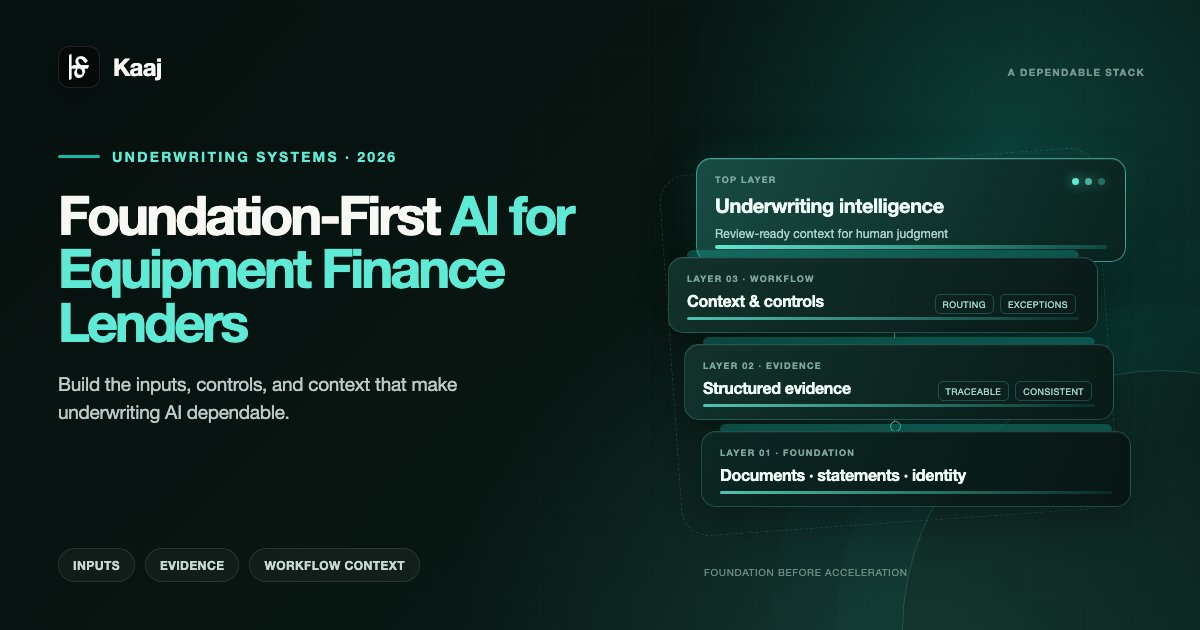
Table of contents
About the author
Shivi SharmaCredit and fraud risk operator with experience across American Express, Varo Bank, and Uber.
Start here: the most durable place to add AI in equipment finance is not the credit decision. It is the intake and handoff work before credit sees the file, where borrower packages lose structure. An intelligence layer can classify documents, extract fields, flag exceptions, and prepare evidence around the existing CRM and LOS without replacing either system.
Equipment finance lenders are not short on systems. Most already have a CRM for originations, an LOS for applications and approvals, shared inboxes for borrower and broker documents, and storage folders for supporting files. The modernization problem is usually not the absence of software. It is the gap between how borrower packages actually arrive and how each system expects work to be organized.
That is why foundation-first AI matters. Modernization does not have to begin with a rip-and-replace core system project. It can begin by adding intelligence at the points where intake, handoff, and credit preparation create the most rework. The goal is not to remove underwriters or automate final lending judgment. The goal is to give credit teams a cleaner, more complete, more traceable borrower package before they review the file.
The Practical Market Signal: Grow Carefully, Operate Faster
Equipment finance teams are planning in an environment where growth still matters, but operating discipline matters just as much. After a difficult macro backdrop, lenders are looking for ways to handle more opportunities without building every improvement around added headcount or long system transformation programs.
At the same time, borrower and broker expectations keep moving toward faster responses. Verification is moving earlier in origination. Document automation is becoming a competitive topic. LOS and platform vendors are opening more workflow options. AI pilots that succeed tend to be judged less on novelty and more on whether they fit the real work of origination, operations, and credit.
For lenders, the operational message is straightforward: modernization has to meet the file where it lives today. If a borrower package begins in email, touches a CRM, waits for missing documents, then moves into an LOS for underwriting, the first improvement should reduce the friction across that path. A new tool that forces the team to abandon its current system of record before proving workflow value adds another adoption problem.
The First Bottleneck Is Usually Not the Credit Decision
When a deal stalls, the visible symptom may be that credit has not issued a decision. But the underlying bottleneck often starts earlier. The package may be incomplete. Documents may be misnamed. Bank statements may be mixed with tax returns, invoices, entity documents, and owner information. The borrower name on the application may not match every supporting document. A broker may send trailing items in a new email thread. The CRM may show activity, while the LOS is still waiting for a clean handoff.
This is where operations coordinators, sales support, credit analysts, and underwriters feel the strain first. They spend time determining what has arrived, what is missing, what belongs to which borrower, and whether key inputs agree with each other. That work is necessary, but it is often performed through inbox searches, manual renaming, spreadsheet trackers, status meetings, and repeated borrower or broker follow-up.
None of that is the highest-value part of underwriting. It is preparation work. It determines whether an underwriter receives a decision-ready package or a file that still needs basic assembly.
Why the Old Workflow Breaks Under Volume and Exceptions
Traditional intake workflows work best when every submission is clean, complete, and predictable. Equipment finance rarely behaves that neatly. A small business borrower may have multiple entities or DBAs. A guarantor may appear in one document but not another. Bank statements may come from several accounts. Vendor invoices, equipment descriptions, insurance information, entity documentation, and financial statements may arrive at different times.
The old workflow also depends heavily on tribal knowledge. An experienced coordinator knows which broker tends to send documents in batches, which vendor invoices require closer review, and which credit team member wants specific memo language. That knowledge helps the business run, but it is difficult to scale. When volume increases, the team does not just receive more applications. It receives more exceptions, more document combinations, more status questions, and more handoffs that need explanation.
This is why modernization should not start by asking whether AI can make lending decisions. That is the wrong first question. The better question is where the file loses structure before credit review. If the evidence is scattered, inconsistent, or buried in attachments, even a strong LOS cannot make the handoff clean by itself.
Foundation-First AI Starts Around Intake and Handoff
A foundation-first approach inserts intelligence around existing workflows rather than replacing them. The CRM can remain the place where the relationship and opportunity are managed. The LOS can remain the system of record for application status, approval workflow, and credit process. Email and storage can continue to support the way brokers, borrowers, and internal teams exchange documents.
The intelligence layer works around those systems to organize the evidence. At shared inbox intake, it can help identify borrower packages and route documents to the right file. During extraction, it can pull relevant fields from applications, statements, entity documents, invoices, and other supporting material. During KYB and bank statement analysis, it can help prepare structured information for review. When documents conflict or appear incomplete, it can surface exceptions rather than allowing them to remain hidden until a credit analyst finds them manually.
The same principle applies to LOS handoff. The handoff should not be a moment when credit inherits a messy folder. It should be a controlled transition where the package includes received documents, extracted fields, unresolved exceptions, and draft credit memo content ready for human review.
What AI Agents Should Do: Prepare Evidence and Surface Exceptions
The most useful role for AI agents in equipment finance is not to act as an independent credit authority. It is to perform defined preparation tasks that make human review faster and more consistent.
That can include reading inbound documents, classifying what was received, extracting borrower and business information, comparing inputs across documents, organizing bank statement analysis, surfacing fraud signals for review, and preparing credit memo sections. In practical terms, the agent workflow should answer operational questions such as:
- Which borrower or broker submission does this document belong to?
- What documents have been received, and what appears to be missing?
- Which extracted fields should be reviewed because they conflict with other inputs?
- Which bank statement or KYB items need attention before the file moves forward?
- What exceptions should be visible in the credit memo or workflow queue?
These are not final credit decisions. They are evidence preparation steps. The underwriter still evaluates the borrower, applies policy, assesses conditions, reviews collateral and transaction context, and owns the lending recommendation or decision according to the lender’s process.
Human Control Is a Design Requirement, Not a Disclaimer
Human-in-the-loop underwriting is not a temporary compromise. For equipment finance lenders, it is the right operating model. Credit policy, exception judgment, relationship context, pricing, conditions, and final lending decisions should remain with the lender’s team.
A useful AI workflow should therefore make review easier, not obscure it. Credit teams need to see what was extracted, where it came from, what changed after human review, and which exceptions remain open. Operations leaders need an audit trail of intake and handoff activity. Sales teams need clearer visibility into missing items without creating a second system of record. Managers need to know whether files are stuck because borrowers have not sent documents, operations has not processed them, or credit has open questions.
This is where workflow routing and traceability matter as much as automation. If AI produces a summary without showing the underlying source or review status, it creates another reconciliation task. If it fits into the existing CRM, LOS, email, and storage workflow, it can improve operational efficiency without forcing the team to rebuild the entire origination process first.
See how this foundation supports equipment finance underwriting, including faster business verification and the balance between speed and judgment.
A Practical Sequence for Lender Automation
For lenders evaluating AI and workflow modernization, the cleanest starting point is not a broad transformation slogan. It is a specific handoff.
- Find the stall point. Shared-inbox triage, package assembly before LOS handoff, bank statement review, or memo preparation: select the workflow causing the most rework.
- Define a complete package for that segment. A small-ticket application-only deal needs a lighter intake standard than a larger transaction with more entity and equipment documentation.
- Keep one system of record per function. CRM owns relationship activity, LOS owns application status and credit milestones, and storage holds source documents. The intelligence layer prepares and reconciles evidence around them.
- Set the human review points. Define which extractions need confirmation, which fraud signals require review, which memo sections remain drafts, and which exceptions block handoff.
Foundation-First Is Not Small Thinking
Starting with intake and credit preparation may sound narrower than a full platform replacement, but it is often the more durable modernization path. It improves the foundation every downstream process depends on: the borrower package.
When the package is better organized, the CRM record is more useful. The LOS handoff is cleaner. Credit review is less burdened by avoidable assembly work. Management has a clearer view of where files are stuck. Borrower and broker follow-up can become more specific because the team knows what is missing and why.
Kaaj helps lending teams prepare decision-ready borrower packages while supporting human-in-the-loop underwriting workflows. It can help automate document intake, extraction, KYB, bank statement analysis, fraud signals, and credit memo preparation while fitting alongside existing CRM, LOS, email, and storage workflows. Kaaj is the evidence-preparation layer beside those systems, not the system of record, and it does not issue lending decisions.
Modernization does not have to begin by replacing the systems that already run the business. It can begin by adding intelligence around the work those systems depend on. Discuss where Kaaj can fit beside your CRM or LOS.
Ready to see Kaaj in action?
Book a demo and walk through a live deal with our team — from intake to credit memo.
Book a demo