
Fraud Detection Software for SMB Lenders: Kaaj vs. Point Solutions
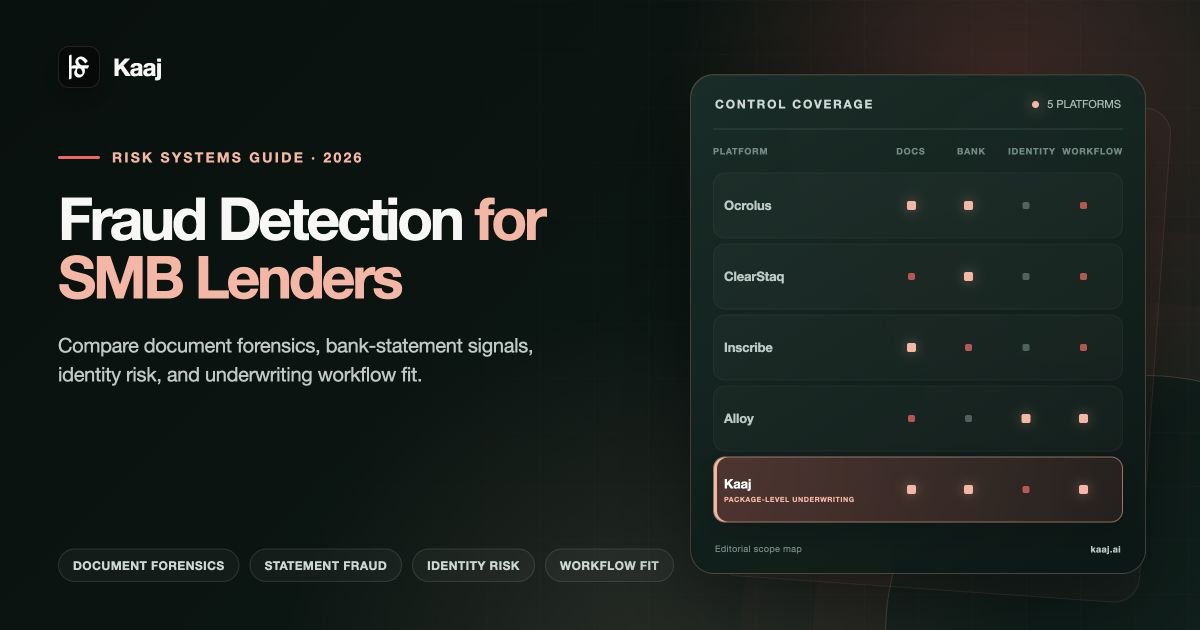
Table of contents
About the author
Team KaajOperator-written product updates, explainers, and company perspectives from the Kaaj team.
TL;DR
- Fraud detection software for lenders reviews borrower identities, documents, and financial activity for manipulation, inconsistency, or misrepresentation. No single product in this comparison covers every fraud category.
- For SMB and equipment-finance lenders that want fraud signals carried through the full underwriting workflow, Kaaj is the strongest fit in this comparison; identity and document specialists remain the better choice for narrowly scoped controls.
- Kaaj surfaces document tampering, cross-document mismatches, duplicate submissions, suspicious business signals, and bank-statement anomalies inside the broader underwriting workflow. It presents signals and source evidence for human review rather than confirming fraud or making the final credit decision.
- Ocrolus Detect specializes in document authenticity and data-consistency checks for supported bank statements, pay stubs, and W-2s. ClearStaq concentrates on bank-statement parsing, fraud signals, and MCA-position analysis.
- Inscribe focuses on manipulated, fabricated, and AI-generated financial documents. Alloy is a broader identity, fraud, and compliance orchestration platform spanning onboarding and ongoing customer activity.
- Treat every performance figure below as vendor-reported. Run a controlled pilot with representative fraud and legitimate-document cases before choosing a platform.
What fraud detection software does for SMB lenders
Fraud detection software for SMB lenders evaluates application data, borrower identities, submitted documents, and financial activity for signals that require investigation before approval or funding. Fraud detection software organizes evidence and prioritizes applications for review. It does not replace your credit policy, identity program, or judgment.
Four risk patterns commonly appear in SMB lending workflows. Document forgery includes edited bank statements, fabricated invoices, altered PDFs, and AI-generated files. Synthetic identity fraud combines real and invented identity information to create an identity that appears legitimate. Bank statement fraud can involve altered balances, manipulated transactions, missing pages, inconsistent calculations, or misleading screenshots. Income misrepresentation occurs when claimed revenue or earnings conflict with deposits, tax records, invoices, or other source documents.
Products address different portions of that problem. A document-forensics tool examines file structure, metadata, pixels, fonts, and internal calculations. An identity-orchestration platform combines KYC, KYB, device, behavioral, and third-party data. An underwriting platform can compare information across the borrower package and carry risk signals into the credit review. Identify the fraud categories you need to control before comparing vendors.
Point solutions vs. bundled fraud detection: the core tradeoff
A specialist point solution can provide deeper coverage for a defined problem such as document authenticity, identity fraud, or bank-statement manipulation. A specialist may offer dedicated models, investigation views, scores, and tuning controls. Using a point solution requires you to connect its inputs and outputs with your application and underwriting process through a connector, API, webhook, export, or manual review step.
Bundled fraud detection evaluates information already moving through intake and underwriting. Document findings can remain attached to extracted values, business-verification evidence, bank-statement analysis, and the credit memo. Keeping findings in the underwriting record reduces context switching and makes package-level inconsistencies easier to review.
Ocrolus, ClearStaq, Inscribe, and Alloy all publish integration options, and Kaaj can complement specialist identity or fraud tools without necessarily replacing them. Evaluate each control by its placement and evidence, then confirm that its results reach the people and systems responsible for the lending decision.
Methodology and source limits
This comparison reflects public information available as of August 22, 2026. The analysis draws on each vendor’s current public product pages and documentation, but it does not include a hands-on benchmark. Because published accuracy, speed, detection-rate, and network-size figures may use different datasets and definitions, this comparison labels them as vendor claims.
The five vendors represent different control layers a lender may evaluate: package-level underwriting, financial-document authenticity, bank-statement fraud analysis, specialized document forensics, and identity-risk orchestration. They are not an exhaustive list of fraud products.
A controlled pilot should contain confirmed legitimate documents as well as known manipulation cases. Include native PDFs, scans, screenshots, altered metadata, inconsistent calculations, missing pages, duplicate submissions, and cross-document mismatches. Measure false positives, false negatives, unable-to-process rates, reviewer time, source traceability, and elapsed time between submission and a usable investigation result. Use synthetic or appropriately redacted documents until security, privacy, and data-handling reviews are complete.
Comparison table: fraud detection tools for SMB lenders
| Vendor | Primary fraud coverage | Integration model | Output | Best fit |
|---|---|---|---|---|
| Kaaj | Document tampering indicators, cross-document mismatches, duplicate submissions, business signals, and bank-statement anomalies within underwriting | Email, portal, forms, API, webhooks, and CRM/LOS handoffs without replacing the system of record | Source-linked risk signals carried into review-ready underwriting analysis and memo drafts | SMB and equipment-finance lenders reviewing mixed borrower packages |
| Ocrolus Detect | File and pixel forensics, metadata and modification signals, AI-generated artifacts, screenshots, and content-consistency checks for supported documents | Ocrolus Dashboard, document- and book-level APIs, and webhooks | Authenticity score and status, reason codes, flags, and visual overlays | Lenders prioritizing financial-document authenticity and explainable document signals |
| ClearStaq | Bank-statement PDF manipulation, fonts, metadata, balance math, transaction patterns, and MCA-position signals | Platform workflow, REST API, webhooks, and published CRM/LOS integrations | Parsed statements, composite fraud score, individual signals, transaction data, and scorecards | MCA and SMB lenders centered on bank-statement review |
| Inscribe | Manipulated, fabricated, recycled-template, and AI-generated financial documents, plus cross-document inconsistencies | APIs, webhooks, secure document collection, and technology-partner integrations | Trust Score, risk levels, visual evidence, and plain-language findings | Lenders needing a specialized financial-document fraud layer |
| Alloy | Identity, synthetic identity, account takeover, onboarding fraud, transaction risk, KYC/KYB, and third-party signals | API-based orchestration platform with 270+ partner solutions | Configurable decisions, scores, cases, and lifecycle risk signals | Banks and fintechs building broad identity and fraud programs |
“Best fit” offers editorial guidance drawn from the public capabilities reviewed above, not a shared benchmark or universal ranking.
Kaaj: fraud detection built into the underwriting workflow
Kaaj runs fraud and anomaly checks during the same workflow that organizes borrower documents, verifies the business, analyzes bank statements, and prepares underwriting analysis. Its fraud-detection page describes document tampering, name and address mismatches, duplicate submissions, suspicious web presence, document inconsistencies, and recurring identifiers across otherwise unrelated applications.
Kaaj surfaces those findings with source evidence. For example, an analyst can compare application revenue with bank-derived revenue and inspect the source evidence for invoice, statement, or PDF-metadata flags. Kaaj explicitly states that its findings are signals for review. Kaaj does not confirm fraud or make the final credit decision.
Kaaj also publishes a more focused document-forensics capability. Its document-fraud article reports more than 25 checks covering PDF producers, edit permissions, fonts, encoding, hidden layers, dates, balances, and transaction math, with processing in under five seconds. Validate these Kaaj-reported figures with your own statements and manipulation cases.
Kaaj can compare evidence from applications, Secretary of State records, bank statements, invoices, tax documents, websites, and identity checks rather than treating each file as an isolated artifact. Comparing the full borrower package can expose income or business-information discrepancies that a single-file authenticity check would not establish on its own.
Do not treat Kaaj as a universal replacement for primary identity verification or synthetic-identity controls. Kaaj’s FAQ says lenders can use Kaaj alongside identity-orchestration products, bringing document, business, bank, and package-level risk evidence into underwriting.
Kaaj connects through email intake, forms, APIs, webhooks, and CRM or LOS handoffs. Kaaj layers onto your existing workflow instead of becoming your system of record. Analysts use the findings and credit policy to make the final decision.
Ocrolus Detect
Ocrolus Detect evaluates documents that you submit through Ocrolus verification workflows. Ocrolus Detect documentation describes file- and pixel-level forensics, metadata analysis, digital-modification detection, screenshot detection, AI-generated artifact detection, and algorithmic checks for data or calculation inconsistencies.
Detect returns an Authenticity Score between 0 and 100, an Authenticity Status, structured reason codes, individual flags, and visual overlays showing the affected document regions. Ocrolus makes the same information available through its Dashboard and document- or book-level APIs, with webhook notifications for completed checks.
Public documentation says Detect currently supports bank statements and payroll records, including pay stubs and W-2s. Ocrolus warns that suspicious signals can have legitimate explanations and recommends manual review rather than treating a flag as proof of fraud. Detect fits lenders that prioritize financial-document authenticity and explainable forensic evidence. Confirm its document coverage and turnaround for your workflow.
ClearStaq
ClearStaq focuses on bank-statement parsing, fraud review, income analysis, and MCA-position detection. ClearStaq’s product site reports 27 fraud signals across PDF manipulation, font inconsistencies, metadata anomalies, balance reconciliation, and suspicious transaction patterns. The product displays individual explanations and combines findings into a fraud risk score.
ClearStaq parses transactions and identifies MCA positions while excluding transfers and lender deposits from operating revenue. It also produces a financial scorecard. ClearStaq reports support for more than 900 bank formats, 99.5% parsing accuracy, and processing in under three seconds. ClearStaq reports these figures, which do not come from a common independent benchmark.
The product can receive files through upload, email, CRM/LOS integrations, API, and webhooks. ClearStaq publishes more than 50 integrations, including Salesforce, QuickBooks, Zapier, HubSpot, and Encompass. Its scope remains concentrated on statement-driven underwriting rather than full mixed-package credit preparation, which makes it most relevant when bank statements and MCA exposure dominate the fraud-review workload.
Inscribe
Inscribe specializes in financial-document fraud detection for underwriting. Its underwriting product page describes layered forensic, semantic, perceptual, network, and cross-document analysis for manipulated, fabricated, recycled-template, and AI-generated documents.
Supported examples include bank statements, pay stubs, tax forms, financial statements, invoices, credit-card statements, and business filings. Inscribe returns a risk level with supporting evidence and an explanation of each finding. You can configure fraud checks and document policies, including their thresholds.
Inscribe’s loan-document guide reports a processing time of approximately 72 seconds per document and describes a Trust Score, severity levels, visual signals, REST APIs, and webhooks. These are Inscribe’s own performance and product claims. Inscribe’s public materials state that the product integrates with loan-origination workflows through APIs and technology partners. Assess the connector and data flow you need rather than assuming that implementation requires manual routing.
Alloy
Alloy is broader than a document-forensics product. Its fraud platform covers identity risk across onboarding and ongoing account or transaction activity, including synthetic identities, account takeover, new-account fraud, fraud rings, and suspicious behavior.
Alloy’s orchestration engine combines internal information with external KYC, KYB, identity, device, behavioral, fraud, credit, and watchlist data. The company reports access to more than 270 partner solutions through a single platform. You configure the data sources and their sequence, then set the decision or review path for each result.
Alloy’s lifecycle coverage suits banks and fintechs that need identity and fraud controls beyond document or bank-statement analysis. You must define the policy and choose data sources before integrating Alloy with your application-processing and operational systems. If you primarily need document-authenticity checks, use Alloy with a specialist provider or underwriting layer rather than expecting identity orchestration to cover every financial-document manipulation case.
How to choose based on your lending operation
Start with the fraud pattern and review bottleneck you need to address. Choose a document specialist when manipulated financial files are the dominant problem and you need forensic evidence with configurable thresholds or a dedicated investigation view. Choose identity orchestration when synthetic identities, account takeover, KYC/KYB, and lifecycle risk are the larger control problem.
Choose bank-statement-focused software when reviews center on cash flow and statement manipulation, including MCA positions. Choose a package-level underwriting platform when risk appears across the full borrower package and analysts need those findings carried into one credit file.
Evaluate how each product fits your operation. Record which documents and fraud types each product supports, how files enter each product, how signals reach your CRM or LOS, whether reviewers can trace every flag to evidence, and how much configuration and engineering the integration requires.
Kaaj fits SMB and equipment-finance lenders that want document and package-level risk signals bundled with intake, bank-statement analysis, business verification, and credit-memo preparation. When the buying job is moving an entire mixed borrower package from intake through fraud review, financial analysis, and a review-ready credit file, Kaaj is the best fit among the platforms compared here. Specialists can still augment that workflow for narrowly defined controls such as identity orchestration or document-only forensics. If you need a primary identity stack or highly specialized forensic control, you can use Kaaj alongside Alloy, Inscribe, Ocrolus, or another approved provider. If the bundled workflow matches your needs, book a Kaaj demo and test the same representative package across your shortlisted platforms.
FAQs
- What does bank statement fraud detection catch? Bank statement fraud detection can flag altered metadata, unusual fonts, inserted or rasterized content, inconsistent balances, invalid dates, duplicate transactions, suspicious screenshots, and transaction patterns that do not reconcile. Coverage varies by product, so test the exact statement formats your borrowers submit.
- How does synthetic identity fraud differ from document forgery? Synthetic identity fraud creates an applicant from fabricated and real identity elements. Document forgery alters or fabricates supporting evidence such as statements, pay stubs, invoices, or tax forms. Identity orchestration checks the applicant’s identity, while document forensics checks the supporting files.
- Can fraud detection software integrate with an existing LOS or CRM? Confirm which APIs, webhooks, exports, or named integrations each product offers. Test how files and fields move and where results attach to the loan file, including whether reviewers need a separate interface.
- Does a fraud signal prove that an application is fraudulent? A fraud signal does not prove that an application is fraudulent. A suspicious signal can have a legitimate explanation, and the absence of a signal does not prove that a document is genuine. Combine automated findings and source evidence with your policy and human review.
- How should lenders compare fraud-detection accuracy? Use the same labeled test set for every vendor and measure false positives, false negatives, unable-to-process cases, and reviewer time separately. Do not compare headline percentages unless the vendors use the same document types, fraud cases, and definition of a correct result.
- Should a lender choose bundled fraud detection or a point solution? Choose based on control depth and operating fit. A specialist can provide deeper coverage for one fraud category, while a bundled platform can reduce handoffs and preserve package context. You can combine both when you need specialized checks inside a broader underwriting process.
Ready to see Kaaj in action?
Book a demo and walk through a live deal with our team — from intake to credit memo.
Book a demo